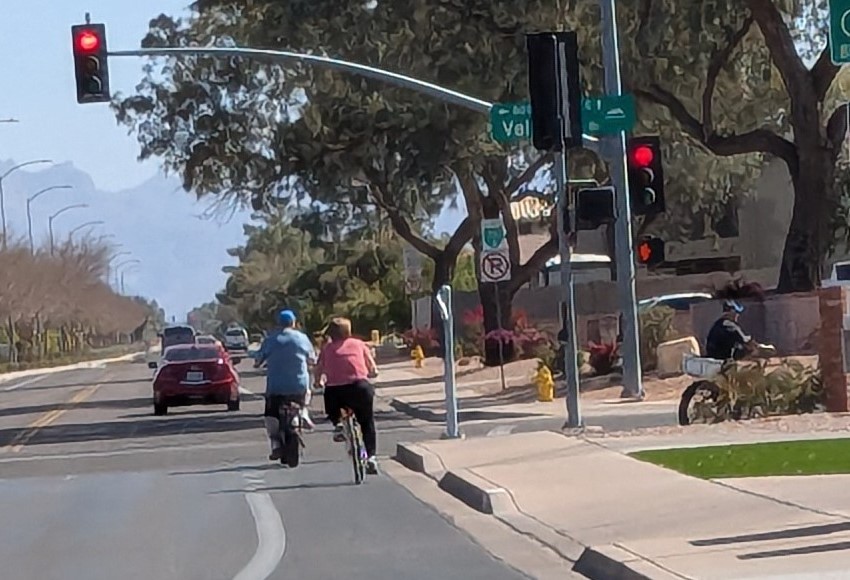
The Arizona Department of Transportation is continuing to develop guidance documents on ways to improve safety for people who walk and people who bike. The Coalition of Arizona Bicyclists participated in the development and provided input on the 2023 and 2024 plans. It is our goal as Active Arizona, to be involved in the development of the 2026 State Active Transportation Plan.
2023: ADOT published the Vulnerable Road Users Safety Assessment.
2024: ADOT published the Active Transportation Safety Action Plan and updated the Arizona Strategic Highway Safety Plan, both of which include information on making roadways safer for active transportation users.
2026: There is funding in the 2026 budget for ADOT to update the State Active Transportation Plan. ADOT last updated the Statewide Bicycle & Pedestrian Plan in 2013.
According to the Arizona Department of Transportation, there are an average of 650 cars crashes in the state every day (all types of crashes, not just vulnerable road users). [1] And those crashes cost us almost $21 billion in 2024.[2] These ADOT plans provide information that can be used to reduce crashes and their associated deaths, injuries, and costs. Making changes to improve safety for people outside of cars makes the roadway safer for all people, including people in cars.[3]
While these documents have different definitions for vulnerable road users and people who engage in active transportation, there are some common themes for improving safety for people who walk and people who bike on public roadways.
All three documents updated in 2023 and 2024 recommend developing roadways using the Safe Systems Approach and recommend:
- Separating Different Types of Road Users in Time
- Separating Different Types of Road Users in Space
- Increased Attentiveness and Awareness
- Reducing Motor Vehicle Speeds
- Reducing Impact Forces
Both the Vulnerable Road Users Safety Assessment and the Active Transportation Safety Action Plan include specific locations where it is recommended that the state and communities take specific action to reduce death and serious injury to people outside of motor vehicles.
You can find an overview of the recently updated documents below. If you see that there are improvements that can be made in your community, please share this information with your local, county, regional and state transportation agencies to make our roadways safer for all.
2023 Arizona Vulnerable Road Users Safety Assessment
“The Vulnerable Road User Safety Assessment (VRUSA) is a statewide initiative to improve safety for Vulnerable Road Users (VRU) in Arizona. The VRUSA will serve as a first step in the development of Arizona’s 2024 Strategic Highway Safety Plan (SHSP) and Active Transportation Safety Action Plan (ATSAP).”[4]
A vulnerable road user is defined in this document as:
- A non-motorist (pedestrian, bicyclist, other cyclist)
- Person on personal conveyance
- Worker on foot in a roadway work zone
- Roadway incident responder (e.g., first responder) working a roadway incident on foot
- Does not include motorcycle or e-bike riders
The document recommends developing roadways using the Safe Systems Approach and recommends:
- Separating Different Types of Road Users in Time
- Separating Different Types of Road Users in Space
- Increased Attentiveness and Awareness
- Reducing Motor Vehicle Speeds
- Reducing Impact Forces
The document includes 13 pages of safety countermeasures that can be implemented. These countermeasures are listed as low cost, medium cost, and high cost. Within those cost categories the countermeasures are divided into the following sub-categories:
- Engineering
- Education
- Enforcement
- Data Collection
Examples of low-cost countermeasures include:
- Include additional lateral space for bicycles on roadway cross-sections
- Improve sight distance and visibility between drivers and VRUs
- Reduce speed limits
- Proactively maintain pavement markings
- Integrate Safe System principles into all levels of transportation planning
Examples of medium-cost countermeasures include:
- Improve pedestrian signal equipment
- Conduct Road Safety Assessments at high-risk locations
- Develop and implement Complete Streets program and guidelines
- Evaluate roadway speeds regularly
- Provide bicycle detection at signalized intersections
Examples of high-cost countermeasures include:
- Implement raised medians or barriers
- Implement traffic calming measures
- Install pedestrian facilities (e.g., marked crosswalks, raised crosswalks, refuge islands, and sidewalks, HAWK)
- Install bicycle facilities (e.g., bike lanes, separated bike lanes, bike boulevards, and off-road multi-use paths, Bike HAWK
- Improve roadway lighting, particularly at high-risk VRU-vehicle conflict areas
The Vulnerable Road Users Safety Assessment also includes maps with specific areas where people walking and people riding bicycles are at higher risk of fatal or serious injury crashes. These locations are in:
- Phoenix
- White Mountain Apache Tribe (WMAT)
- Yuma (City)
- Tucson
- Gila River Indian Community
- Mesa
- Golden Valley (Mohave County)
- Prescott
- Catalina (Pima County)
- Apache Junction
These 10 recommended safety assessments cover:
- 14 of the top 20 pedestrian safety locations
- 9 of the top 20 bicyclist safety locations
- 62% of VRU serious injury and fatal crashes statewide (2013-2022)
- 7 locations with high underserved population
2024 Arizona Active Transportation Safety Action Plan (ATSAP)
“The Arizona Active Transportation Safety Action Plan (ATSAP) is a statewide initiative to improve safety for active transportation users in the state of Arizona. The ATSAP applies to the State Highway System (SHS) owned or operated by the Arizona Department of Transportation (ADOT).”[5]
Short-Term Goal: Reduce life-altering crashes involving pedestrians and bicyclists on the State Highway System by 20% by 2030.
Long-Term Goal: Eliminate all life-altering crashes involving pedestrians and bicyclists on the State Highway System.
Active transportation is defined in this document as:
- any non-motorized mode of transportation, typically people walking and people riding bicycles.
The document recommends developing roadways using the Safe Systems Approach and recommends:
- Separating Different Types of Road Users in Time
- Separating Different Types of Road Users in Space
- Increased Attentiveness and Awareness
- Reducing Motor Vehicle Speeds
- Reducing Impact Forces
The document makes the following policy recommendations:
- Planning to Programming (P2P) Safety Prioritization
- Pedestrian-Friendly and Bicyclist-Friendly Interchanges
- Updates to the ADOT Roadway Design Guidelines
- Signalize Channelized Right-Turn Lanes
- Legislative Recommendations
The Arizona Active Transportation Safety Action Plan also includes maps with specific areas with current higher risk of fatal or serious injury crashes and predicts future high-risk locations. The document includes specific locations and specific actions for 26 locations where improvements are needed. These locations are in the following counties:
- Coconino
- Gila
- Graham
- Maricopa
- Mohave
- Navajo
- Pima
- Pinal
- Yavapai
2024 Arizona Strategic Highway Safety Plan
“The Arizona Strategic Highway Safety Plan (SHSP) is a statewide coordinated plan that provides a comprehensive framework for reducing fatalities and serious injuries on all public roads in Arizona.” [6]
GOAL: REDUCE LIFE-ALTERING TRAFFIC CRASHES BY 20% BY 2030.
The SHSP recommends developing roadways using the Safe Systems Approach, and recommends:
- Separating Different Types of Road Users in Time
- Separating Different Types of Road Users in Space
- Increased Attentiveness and Awareness
- Reducing Motor Vehicle Speeds
- Reducing Impact Forces
- Design Improvements
The SHSP recommends the following strategies as priorities:
- Improve visibility of VRUs, all users, and roadway features
- Incorporate VRUs more prominently in planning, design, and programming process
- Reduce high-risk movements
- Keep vehicles in their lane
- Conduct high-visibility enforcement at intersections
- Promote safety at crash scenes
- Improve Tribal crash data collection and sharing
While the SHSP has an appendix titled Detailed Recommended Strategies, there is nothing listed in that section
References:
[1] _____, The hidden cost of car crashes in Arizona, ABC 15 News, 2025, https://www.abc15.com/news/operation-safe-roads/the-hidden-cost-of-car-crashes-in-arizona
[2] _____, Crash Trends, Maricopa Association of Governments, 2025, https://azdot.gov/sites/default/files/2025-07/2024-Crash-Facts.pdf
[3] Ratledge, Bike Lanes Make Roads Safer for All Road Users, Coalition of Arizona Bicyclists, 2023, https://www.cazbike.org/bike-lanes-make-roads-safer-for-all-road-users/
[4] _____, Arizona’s Vulnerable Road User Safety Assessment, Arizona Department of Transportation, 2023, https://azdot.gov/sites/default/files/2023-11/ADOT-Vulnerable-Road-User-Safety-Assessment_Final-111523.pdf
[5] _____, Arizona Active Transportation Safety Action Plan, Arizona Department of Transportation, 2024, https://azdot.gov/sites/default/files/2024-10/atsap-final-10-15-24-noappendices.pdf
[6] _____, Arizona Strategic Highway Safety Plan, Arizona Department of Transportation, 2024, https://azdot.gov/sites/default/files/2024-10/arizona-shsp-final-10-15-24-noappendices-signed.pdf