Are YOU the new face of bicycling in Arizona?

Are YOU the new face of bicycling in Arizona? Do you have a vision of the future of bicycling in our state and would like to share talents and contribute ideas on making it a reality? Just want to get involved?

The Coalition of Arizona Bicyclists is seeking interested bicyclists for  Board of Directors and Officer positions to be filled at our annual meeting.  Directors are elected by the membership bi-annually, elections will be held at our upcoming Annual Membership Meeting. Nominees do NOT need to be present at the meeting to be elected. 

Directors’ duties include regularly attending a Director’s meeting . Since directors can (and should!) reside all around Arizona, meetings are routinely held via via tele-conference.

Please contact us at cazbike@cazbike.org with a brief bio/background; or with the nomination of someone you think would be a good candidate. As always we are looking for volunteers in any capacity, not just directorial; please drop us a line, or better yet attend the annual membership meeting, being held this year on TBD (details forthcoming).

Are you interested in improving conditions for bicyclists in Arizona? The CAzB is actively seeking Board and Officer candidates especially with any of the following experience:

  • Grant writing for non-profit entities, preferably bicycling-related.
  • Donor fund-raising, preferably bicycling and/or community-oriented.
  • Membership development campaigns.
  • Bicycling event planning, organizing and management for paid events >200 bicyclists.

Can’t commit to a leadership role? The Coalition is always seeking individuals that can contribute in any way.

Contact us: cazbike@cazbike.org, or message us on facebook.

The Coalition of Arizona Bicyclists; providing education and advocacy to Arizona’s bicyclists.

Coalition of Arizona Bicyclist’s Annual member’s meeting 10/18/2016


There is a plan to hold an in-person meeting sometime in the Spring 2017 as we transition our corporate year for Arizona Corporation Commission purposes.


Below are the minutes of the meeting (approved at the 3/21/2017 Board of Directors meeting):

2016 Annual Meeting Minutes

Tuesday, October 18, 2016 Attendees: Bob Beane, Bob Jenson, Wayne Churchman, Ed Beighe, Peter Mather, Gail Hildebrant, Sharon Newman Matt, Lloyd Thomas, Jeff Kafleck, Radar Matt

Called to order at 1837

Treasures Report Gail Hildebrant Checking Account $725.15 Savings Account $515.53 High Yield Account $32,872.55 Total 34,113.23 Report was accepted. Spread sheet shows that regular spending is typically under $2,000/yr. Most of that is for the storage locker & the monthly conference bridge.

Overview of what we are working on: State level: GOHS, ADOT, More input into the drivers license testing. Improve PSA/bikes Power point that was created for GPD. Sierra Vista PD has made contact.

Maricopa County: E bike – California has law classifying an E bike as a motorcycle. Tempe is in the process of drafting its own city laws. We need to get ahead of this, so we don’t end up with a lot of city or county ordinances.

Pecos Freeway: PARC & GRIC are still trying to block it. Sit is still unclear if cyclist will have access to the shoulder. Next meeting is 10/20/16 at the State capitol.

Regional priorities: Tucson- Yuma- Tempe-Lloyd Thomas-Traffic counts support the traffic calming on McClintock. Metro Phoenix-Bob Jenson- Light rail is extending to Dunlap for Metro Center access. No increase in bike facilities on the light rail. City is looking into putting bike lanes on several E-W major streets. Next meeting 10/20 at College of America

Bike Summit: still questionable Fri 3/31 or Sat. 4/1 Wayne Churchman to get back to us next week, on whether Perimeter would split the cost of the rooms. We need to take a survey of what last year attendees would care for.

Elections: CAzB is now at 8 Board Members with the resignation of Ben Dodge.

Pima County Enacts Texting Ban

Pima county follows action by the cities of Phoenix, and Tucson (see this article for more about Tucson), and Flagstaff as well as Coconino County, with various bans on electronic communications while driving. The state legislature has repeatedly failed to act regarding limits on use of electronic devices while driving.

Sheriff Chris Nanos worked diligently with the Pima County Government Board of Supervisors to construct a new ordinance that prohibits texting and driving in Pima County. On May 17, 2016, the ordinance was approved. It became effective on June 16th, 2016.

According to this ordinance (10.34.020): A person may not, while driving a motor vehicle on a highway, manually manipulate a handheld electronic device for any purpose other than to initiate, receive, or engage in voice communication. It is a civil traffic offense to violate this ordinance. — see more

Click here for ordinance 10.34.020


Here is a text copy of the full ordinance:

ORDINANCE NO. 2016- 31

AN ORDINANCE OF THE BOARD OF SUPERVISORS OF PIMA COUNTY, ARIZONA, RELATING TO THE USE OF HANDHELD ELECTRONIC DEVICES WHILE OPERATING A MOTOR VEHICLE. (All Districts)

The Board of Supervisors of Pima County, Arizona, finds that:

1. The Pima County Board of Supervisors has the authority under Arizona Revised Statutes (“A.R.S.”) § 11-251(4) to lay out, maintain, control, and manage public roads, ferries, and bridges within the County; under A.R.S. § 11-251(17) to adopt provisions necessary to preserve the health of the County; and under A.R.S. § 11- 251 (31) to make and enforce all local, police, sanitary, and other regulations not in conflict with the general laws.

2. The Pima County Board of Supervisors has authority under A.R.S. § 28-626(8) and A.R.S. § 11-251.05 to adopt, by ordinance, additional traffic regulations on Pima County highways that are not in conflict with A.R.S. Title 28, Chapters 3, 4, or 5.

3. The use of handheld electronic devices while operating motor vehicles has increased in recent years and causes distracted driving, which has been shown to increase the risk of motor-vehicle crashes.

4. The Arizona Legislature, to date, has not enacted legislation directly regulating the use of handheld electronic devices while operating a motor vehicle.

5. Regulation of the use of handheld electronic while operating a motor vehicle will protect the public health and safety by promoting and encouraging safe driving on Pima County highways.

BE IT ORDAINED BY THE BOARD OF SUPERVISORS OF PIMA COUNTY, ARIZONA:

Section 1. Title 10 of the Pima County Code is amended to add new chapter 10.34 to read as follows:

Chapter 10.34 USE OF HANDHELD ELECTRONIC DEVICES WHILE OPERATING A MOTOR VEHICLE

10.34.010 Purpose and intent.

The purpose and intent of this ordinance is to promote public safety in Pima County by restricting the use of hand held electronic devices while operating a motor vehicle on Pima County highways.

10.34.020 Prohibited conduct.

A person may not, while driving a motor vehicle on a highway, manually manipulate a handheld electronic device for any purpose other than to initiate, receive, or engage in voice communication. For purposes of this section, “drive” and “motor vehicle” have the same meaning as those terms are given in Arizona Revised Statutes Title 28, Chapter 1.

10.34.030 Exemptions.

Section 10.34.020 does not apply to any of the following: 1. Use of handheld electronic devices by authorized law enforcement or emergency personnel in the performance of official duties. 2. A person driving a school bus or transit vehicle that is subject to Arizona or United States Department of Transportation regulations. 3. Use of a hand held electronic device on property that is not open to vehicular travel by the general public. 4. Use of a handheld electronic device while a motor vehicle is stationary.

10.34.040 Classification and penalty.

A. A violation of Section 10.34.020 is civil traffic violation. B. A peace officer may stop and issue a citation to a person operating a motor vehicle on a highway if the peace officer has reasonable cause to believe that a violation of Section 10.34.020 has occurred. C. A person who violates Section 10.34.020 and is not involved in a motor vehicle crash is subject to a civil penalty of one hundred dollars ($100.00), plus any other penalty assessments authorized by law. D. A person who violates Section 10.34.020 and is involved in a motor vehicle accident is subject to a civil penalty of two hundred fifty dollars ($250.00), plus any other penalty assessments authorized by law.

10.34.050 Severability.

If any provision of this chapter, or the application of any provision of this chapter, is invalid, that invalidity shall not affect other provisions or applications of this chapter. The provisions of this chapter are severable.

Section 2. The various County officers and employees are authorized and directed to perform all acts necessary or desirable to give effect to this ordinance.

Section 3. This ordinance is effective 30 days after the date of adoption. PASSED AND ADOPTED by the Board of Supervisors, Pima County, Arizona, this 17th day of May , 2016. ~


 

Rich Corbett Biked to Work For 36 Years

Rich Corbett, a veritable fixture on the Tuscon and Pima County cycling scene for decades has succumbed to Alzheimer’s disease. As an LCI, a League of American Bicyclists Certified cycling Instructor, Rich taught hundreds of cycling safety classes to cyclists; as well as being an LCI “coach” — certified to train new LCIs.

He was a transportation planner for ADOT and PAG. He earned the rank of Eagle Scout, was a scout master, and served as Trail Steward on the AZ Trail. He rode 200,000+ miles and devoted his knowledge and energy to bicycling: Grand Canyon to Mexico bike tour, El Tour, Team in Training, BAC, and more. He is survived by wife, Connie; sons, Brian and Jason; brother, Bob and sister, Debbie. In lieu of flowers, donations to of America or Catalina Council of Boy Scouts would be appreciated. All are welcome at the Desert Museum on Friday, April 1, 2016 at 11:00 a.m. to celebrate a life well lived. Arrangements by HUDGEL’S SWAN FUNERAL HOME.


Here’s an auto-biographical article Rich wrote in the late-2000’s… At the time he had only ridden 180,000 miles 🙂


Rich Corbett Biked to Work For 36 Years

By Richard Corbett, 36 Year Everyday Bike Commuter

richCorbettIt was a long time ago that I started bike commuting (January 1971). So, you ask, why


did I start?
Well, I had gone through ROTC at the University of Arizona, and was commissioned upon graduation in June 1968, as a US Army Transportation Officer. The Army granted me a waiver to continue on to graduate school, as I was pursuing a graduate degree with a ‘major’ in transportation engineering. The Army liked having their officers educated in the fields they would be working in.
My graduate degree took three full years to complete, and in the middle of the third year, I received my orders for active duty (that Fall).
I was working part time as a planner in the City Planning Division, and one of my coworkers rode a bike back and forth to work. I knew that when I went on active duty, I would need to be in good condition, so I thought, ‘bicycle riding will help me get in shape’.
My eight year old nephew had just won a bicycle in a drawing, but he already had one, so I ‘bought’ the rights to the one he had won, and picked out an adult size bike from the dealership. I added wire baskets on the rear, and began to ride the three miles back and
forth to work in January 1971.
I quickly found out it was fun! I also was able to save the parking fee I paid ($4/month), as well as saving gas. Later, my auto insurance company found out I was not driving to work, and reduced mi auto insurance. I was saving money three different ways!
The first thing I did upon returning from active duty was to buy a better bicycle, and begin to ride farther (more exercise). As time passed, I took to riding ‘loops’ to add more and more miles. I then realized why ’bikers’ wore those funny shorts, when my trousers
began to wear thin at the friction points!
The years seemed to fly by as the miles added up and in early 1979 I joined the local bike club – Los Turistas. My love and enjoyment of cycling grew and grew.
I rode my first century in September 1979, and that was the beginning of at least one (and often more) century rides per year. I have now ridden 90 centuries, and have ridden over 183,000 miles on my bicycles.
I later found out that more than half of Tucson area residents live within 5 miles of their workplace. That is an easy distance to bicycle, especially when you ride early in the morning, and then riding home at the end of the day – what does it matter if you get sweaty?
The benefits of bicycle commuting include:

  • Saves you money on auto related expenses: gas expenditures, auto insurance, parking fees. The average annual price of running and maintaining a car is $8,410 a bike averages $200.
  • You reduce traffic, congestion, time spent commuting, and don’t have to hunt (or possibly pay) for parking
  • Helps keep (or get) you physically fit doing something you have to do anyway – travel to work. Sadly, over 60% of Americans are overweight, or obese (an
    increase of 40% in the last 10 years!)
  • Easy way to get the recommended 30 minutes a day of exercise -seven out of ten do not get this recommended exercise
  • Helps reduce air pollution

Bike commuting? It is a really special way to get and stay fit, while saving money and helping the environment at the same time !

tucsonaz.gov/files/bicycle/richCorbett.pdf

Lobbying

The Coalition is an exempt organization recognized by the IRS as a public charity under 501(c)3 since 2002. Our primary public purpose is bicyclist traffic safety education.

501(c)3 charities are “absolutely” prohibited from endorsing any candidate for elective public office.

Influencing legislation (“lobbying”) is, however, permitted so long as it does not amount to  a “substantial part of its activities”. The Coalition does, from time to time, participate in influencing legislation, however it does not amount to a substantial part of our activities. Note that lobbying does not include activities involving “executive, judicial, or administrative bodies” (examples include ADOT, MAG, PAG, etc).

Below is reference material from the IRS:


The Restriction of Political Campaign Intervention by Section 501(c)(3) Tax-Exempt Organizations
Under the Internal Revenue Code, all section 501(c)(3) organizations are absolutely prohibited from directly or indirectly participating in, or intervening in, any political campaign on behalf of (or in opposition to) any candidate for elective public office. Contributions to political campaign funds or public statements of position (verbal or written) made on behalf of the organization in favor of or in opposition to any candidate for public office clearly violate the prohibition against political campaign activity.  Violating this prohibition may result in denial or revocation of tax-exempt status and the imposition of certain excise taxes.

Certain activities or expenditures may not be prohibited depending on the facts and circumstances.  For example, certain voter education activities (including presenting public forums and publishing voter education guides) conducted in a non-partisan manner …more


Lobbying
In general, no organization may qualify for section 501(c)(3) status if a substantial part of its activities is attempting to influence legislation (commonly known as lobbying).  A 501(c)(3) organization may engage in some lobbying, but too much lobbying activity risks loss of tax-exempt status.

Legislation includes action by Congress, any state legislature, any local council, or similar governing body, with respect to acts, bills, resolutions, or similar items (such as legislative confirmation of appointive office), or by the public in referendum, ballot initiative, constitutional amendment, or similar procedure.  It does not include actions by executive, judicial, or administrative bodies.

An organization will be regarded as attempting to influence legislation if it contacts, or urges the public to contact, members or employees of a legislative body for the purpose of proposing, supporting, or opposing legislation, or if the organization advocates the adoption or rejection of legislation.

Organizations may, however, involve themselves in issues of public policy without the activity being considered as lobbying.  For example, organizations may conduct educational meetings, prepare and distribute educational materials, or otherwise consider public policy issues in an educational manner without jeopardizing their tax-exempt status.

..

Beane: ADOT needs to broaden its concept of transportation

Commentary by Coalition President Bob Beane, regarding the South Mountain Freeway (the last remaining unbuilt portion of Loop 202), set to begin construction later this year…

Beane: ADOT needs to broaden its concept of transportation

Posted: Tuesday, January 12, 2016 4:56 pm
Commentary by Bob Beane Special to AFN (Ahwatukee Foothill News)

Roughly six years ago, a locally based Federal Highway Administration official assured me (verbally, of course) that ADOT would be required to accommodate the bicycling community (transportation-oriented and recreational/fitness) if/when the 202 “Pecos” freeway was built going around South Mountain to the west. The “accommodation” requested was/is a road or pathway to connect to 51st Avenue from the western edge of the Ahwatukee Foothills.

Initially, ADOT was gathering related input from bicyclists. But, somewhere along the way, the ”accommodation” seems to have evaporated. Possibly, it coincided with the inability to achieve an alignment that didn’t require costly blasting through two ridges at the west end of South Mountain. So, within a $1.75 billion project with four freeway lanes in each direction (really?), cost savings need to come from NOT providing for any means for bicyclists, pedestrians or any other non-vehicular mode users to be able to cover roughly four miles (or less) between the western edge of the Ahwatukee Foothills and 51st Avenue.

As it stands today, no accommodation is planned that I know of or can discern from publicly released plans. There are no connecting frontage roads, and there are no plans for a bike path in the right of way (as have been built in places such as Colorado or Utah).
However, a concerned group of bicycling advocates and some community leaders from Phoenix, Chandler and Tempe are seeking to at least get ADOT to design in enough space within the right of way to allow a bike path to be constructed. I can’t speak for everyone in the group, but the consensus seems to be that having this connectivity in place would be an equitable and extremely positive non-vehicular transportation connection and recreational amenity that would enhance the neighboring communities.
Setting aside the issue of whether this freeway project is truly needed, it seems to many that ADOT still stands for “Arizona Department of Trucks (and Cars)” and that ADOT remains miles away from being a true transportation department that has a broader vision of its role and potential in contributing a multi-modal environment to the communities in which it operates. ADOT leadership, to date, seems to lack any vision of contributing to the overall health and community environment in a way that other DOTs have embraced for years.
A fraction of a fraction of the cost of this massive project could not only allocate space within the design, but fund a bike path for at least four miles, or so. But, that’s, sadly, not in the plans…yet. As I mentioned, there is a significant constituency that is asking for ADOT to incorporate non-vehicular connectivity into the 202 freeway plans. We are hopeful that ADOT can take a significant community-oriented step forward by approaching this request with a “how can we help make this happen” attitude, rather than the perceived car-centric, liability and cost-based blinders that seem to have guided past decision-making.
Ahwatukee resident Bob Beane is president of the Coalition of Arizona Bicyclists.

PDF of print edition: BeaneAFN_Guest_Commentary


More about the South Mountain Freeway

Official ADOT homepage for SMF. The South Mountain Freeway is the last piece to complete the Loop 202 and Loop 101 freeway system. The freeway is a part of the Regional Transportation Plan funding passed by Maricopa County voters in 2004 by Proposition 400, a 0.5% sales tax, proceeds of which predominantly fund freeway construction.


Arizona Legislation 2016

Arizona’s 52nd Legislature – 2nd Regular Session is now in full swing. Below is a brief guide to following legislation in Arizona… For the nuts-and-bolts of how a bill becomes law, the multiple “readings”, and the COW, and so forth, see e.g. this document from azleague.org Continue reading Arizona Legislation 2016

Curious about Bike Patrol?

P1020280_01by Roseann Wagner
Having participated in bike patrol, I decided to talk to Walt Paciorek, an instructor of the program. Good events require a lot of time and organization led by dedicated people. Here is a way you can give back to a sport that has perhaps given you a great deal of fun.

The information is Walt’s take on the program. The pictures are mine.

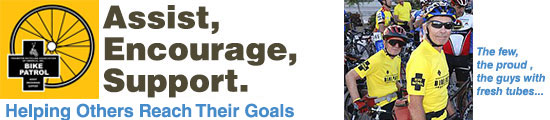
The mission of Perimeter Bicycling’s Bike Patrol Program is to provide assistance, encouragement, and support for the participants of Perimeter events. Patrollers offer mechanical assistance, first aid as needed and encouragement to successfully finish the ride.

Perimeter Bike Patrol is a group of nearly 300 certified cyclists who bring enthusiasm for cycling and a deep pool of experience to ensure the success of thousands of riders in Perimeter events every year.

There is also an award for outstanding Bike Patrol in each event.
And of course, all Bike Patrol receive a finisher’s medallion.

Who can participate?

The typical bike patroller is a fit, experienced, and enthusiastic cyclist with basic mechanical skills (fix a flat, correct a thrown chain); knows and practices the rules and procedures of safe cycling, and is willing to assist and encourage other cyclists. A basic understanding of first aid is helpful but not required.
Different ride distances are available to accommodate all ages and sizes of riders. You ride at your own pace (preferably with a partner), but plan on many stops to help riders.

How much does it pay?

For a modest processing fee you get to ride a great event, a striking yellow tee-shirt, a cool medallion, excellent sag stops, and a priceless amount of appreciation and satisfaction. While maybe not rock-star status, you will receive many positive strokes from those you help or who have been helped by others in the past.

What do I have to do to qualify?

Register, attend a certification course, show up early to help at the start, and agree to do all you
can to ensure participants will have a safe and fun event. If you are uncertain about your qualifications, you may request to be paired with an experienced Bike Patroller or team. Review the Bike Patrol Manual (available on-line) before you attend the certification class. Classes are normally held several times each fall; and are held in both Phoenix and Tucson.

How long do I have to be at the event?

Be there early to help at the start, complete the ride, check in at the finish, pick up your
medallion, and then you are finished.

Why is patrol necessary?

A surprising number of riders will need your assistance. They appreciate getting back on the road promptly without a long wait for sag assistance. Bike Patrollers are the eyes and ears of the tour, ready to report or correct problems and assist with mechanical, medical, and motivational emergencies in real time.

Do I have to provide tubes and tire-changing tools?

You will be advised about what tools are useful at the certification class. You may receive a tube or two at packet pickup. Most riders will have their own tubes. A few will not. I always carry a few patched road bike tubes for those who need them and a glue-less (Park is the best) patch kit for odd-sized wheels.

What are other duties of bike patrol?

Assistance, encouragement, and support are paramount. Call in or text every time you stop to provide assistance, or at least at every sag stop. If you observe riders behaving badly or breaking event rules, ask them to mend their ways. If they do not cooperate, report their rider numbers and the circumstances via text, call, or at the next sag stop. There will be consequences.

What do I do if I encounter a crash?

Secure safety for any victims and, if serious, call 911. Provide any first aid that you comfortably can. Stay until help arrives or you are certain a rider can continue. Report the incident via text or call. Complete a report form for all but simple events handled on-site. There can be an events that will be challenging. Some examples I have encountered are hypothermia, hyponatremia, diabetic incidents, heat distress, and severe cramps. These are mid-level events that can be treated on-site if caught early, but can also require professional medical attention. You will make the call – treat, call for support/pickup, or call 911.

What should I do to be prepared?

Be sure your own bike is in good shape before the ride. Bring a fully-charged cell phone.
Between the Bike Patrol Manual and the certification class, you will be prepared. Ride with a partner for fun, efficiency in carrying out duties, and assistance when needed.
If you are interested in being a part of bike patrol, visit perimeterbicycling.com/bike-patrol to learn more and sign up.

P1020292_01