

visit www.cazbike.org/summit for all summit information
Category: News
was “Uncategorized”. All blog posts should have this category
Curious about Bike Patrol?
 by Roseann Wagner
Having participated in bike patrol, I decided to talk to Walt Paciorek, an instructor of the program. Good events require a lot of time and organization led by dedicated people. Here is a way you can give back to a sport that has perhaps given you a great deal of fun.
The information is Walt’s take on the program. The pictures are mine.
The mission of Perimeter Bicycling’s Bike Patrol Program is to provide assistance, encouragement, and support for the participants of Perimeter events. Patrollers offer mechanical assistance, first aid as needed and encouragement to successfully finish the ride.
Perimeter Bike Patrol is a group of nearly 300 certified cyclists who bring enthusiasm for cycling and a deep pool of experience to ensure the success of thousands of riders in Perimeter events every year.
There is also an award for outstanding Bike Patrol in each event.
And of course, all Bike Patrol receive a finisher’s medallion.
Who can participate?
The typical bike patroller is a fit, experienced, and enthusiastic cyclist with basic mechanical skills (fix a flat, correct a thrown chain); knows and practices the rules and procedures of safe cycling, and is willing to assist and encourage other cyclists. A basic understanding of first aid is helpful but not required.
Different ride distances are available to accommodate all ages and sizes of riders. You ride at your own pace (preferably with a partner), but plan on many stops to help riders.
How much does it pay?
For a modest processing fee you get to ride a great event, a striking yellow tee-shirt, a cool medallion, excellent sag stops, and a priceless amount of appreciation and satisfaction. While maybe not rock-star status, you will receive many positive strokes from those you help or who have been helped by others in the past.
What do I have to do to qualify?
Register, attend a certification course, show up early to help at the start, and agree to do all you
can to ensure participants will have a safe and fun event. If you are uncertain about your qualifications, you may request to be paired with an experienced Bike Patroller or team. Review the Bike Patrol Manual (available on-line) before you attend the certification class. Classes are normally held several times each fall; and are held in both Phoenix and Tucson.
How long do I have to be at the event?
Be there early to help at the start, complete the ride, check in at the finish, pick up your
medallion, and then you are finished.
Why is patrol necessary?
A surprising number of riders will need your assistance. They appreciate getting back on the road promptly without a long wait for sag assistance. Bike Patrollers are the eyes and ears of the tour, ready to report or correct problems and assist with mechanical, medical, and motivational emergencies in real time.
Do I have to provide tubes and tire-changing tools?
You will be advised about what tools are useful at the certification class. You may receive a tube or two at packet pickup. Most riders will have their own tubes. A few will not. I always carry a few patched road bike tubes for those who need them and a glue-less (Park is the best) patch kit for odd-sized wheels.
What are other duties of bike patrol?
Assistance, encouragement, and support are paramount. Call in or text every time you stop to provide assistance, or at least at every sag stop. If you observe riders behaving badly or breaking event rules, ask them to mend their ways. If they do not cooperate, report their rider numbers and the circumstances via text, call, or at the next sag stop. There will be consequences.
What do I do if I encounter a crash?
Secure safety for any victims and, if serious, call 911. Provide any first aid that you comfortably can. Stay until help arrives or you are certain a rider can continue. Report the incident via text or call. Complete a report form for all but simple events handled on-site. There can be an events that will be challenging. Some examples I have encountered are hypothermia, hyponatremia, diabetic incidents, heat distress, and severe cramps. These are mid-level events that can be treated on-site if caught early, but can also require professional medical attention. You will make the call – treat, call for support/pickup, or call 911.
What should I do to be prepared?
Be sure your own bike is in good shape before the ride. Bring a fully-charged cell phone.
Between the Bike Patrol Manual and the certification class, you will be prepared. Ride with a partner for fun, efficiency in carrying out duties, and assistance when needed.
If you are interested in being a part of bike patrol, visit perimeterbicycling.com/bike-patrol to learn more and sign up.

Look Ma, no hands!
There is a special law applying specifically to bicyclists; it often gets repeated as
You must have at least one hand on the handlebars at all times
Which is what appears both on the Arizona Governor’s Office of Highway Safety (AZ GOHS), and the City of Phoenix websites, it is a misrepresentation.
While this is the law in some places, e.g. Utah (41-6a-S1112); the law in Arizona actually reads:
ARS 28-816. Carrying article on bicycle
A person shall not carry a package, bundle or article while operating a bicycle if the package, bundle or article prevents the driver from keeping at least one hand on the handlebars.
So, while you should and must ride under control for safety’s sake, it’s not intrinsically illegal to ride with no hands.

Fall 2015 BFC: Tempe and Mesa move up
 League Announces Fall 2015 Bicycle Friendly Communities
Tempe move up to Gold. Mesa moves up to Silver. Scottsdale maintains Gold.
Arizona communities currently enjoying BFC status are
- Gold — Tucson/East Pima Region, Scottsdale, Tempe
- Silver — Sedona, Flagstaff, Mesa
- Bronze — Chandler, Cottonwood, Gilbert, Phoenix

World Day of Remembrance for Road Crash Victims
November 15, 2015 is World Day of Remembrance for Road Crash Victims. Right here in Arizona in just the last year , 884 persons were killed in Arizona traffic crashes. This includes 589 motorists, 157 pedestrians, and 28 bicyclists. Many thousands more were injured.
This year the theme is “Crash Not Accident” – an initiative focused on changing the way we think and talk about crashes. Most crashes are not “accidents”, rather they should be viewed as preventable incidents. Yet, the “A” word which connotes some level of innocence, is the ubiquitous term used in describing these incidents by media, some highway safety officials & others. Negligent, and even criminal, drivers hide behind the word, as if “lack of intent” absolves them of their actions and the hurt that they’ve caused. #CrashNotAccident
ASU-Poly, and Downtown campus named Bicycle Friendly
The LAB announced today that the ASU’s Polytechnic campus and ASU’s Downtown Phoenix campus have been named Bicycle Friendly Universities at the Bronze Level. Continue reading ASU-Poly, and Downtown campus named Bicycle Friendly

Tempe adds penalties for dangerous cell-phone using drivers
Tempe city council voted earlier this week to institute penalties on drivers who are driving erratically, or cause collisions due to handheld cell phone use. Notably, the penalty for “aggravated” use — in the case where a serious injury or death occurs — is criminal. The ordinance is reproduced below. News item Tempe OKs toughest texting and driving law in Arizona. Continue reading Tempe adds penalties for dangerous cell-phone using drivers

Coalition advertisements — watch for them!
Coalition ads will be appearing in the Nov/Dec 2015 issue of Tail Winds magazine, and BikeLife Cities magazine (Tempe / Mesa / and Tucson Fall 2015 editions). Watch for it!

The original files are available on our collateral google drive folder:
- CAzB_Ad2-forTailwinds.jpg ; 300dpi, 4.75″ X 6.25″ => 1425 x 1875
- CAzB_Ad2.pdf
.
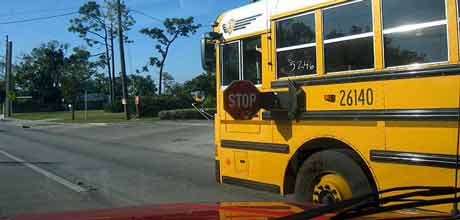
Stop for School Bus
Don’t forget, that as a bicyclist you have the same rights and responsibilities as the driver of a vehicle; you must STOP FOR SCHOOL BUSES when the stop sign/alternately flashing lights are in use… Continue reading Stop for School Bus

Overtaking Bicycles and Arizona’s Three Foot law
this is the next in an occasional series on laws governing bicycle use in Arizona
In the last installment, we noted that a bicyclist is subject to the rights and responsibilities of a “driver of a vehicle”, as well as some special rules which apply specifically to bicyclists; and that there were important legal distinctions between the driver of a motor vehicle and a bicyclist. Today we examine a special responsibility applicable only to the driver of a motor vehicle — the duty to overtake a bicyclist proceeding in the same direction not only safely, but with a minimum of three feet of clearance.
The general rule for a driver overtaking another vehicle is as follows:
§28-723. Overtaking a vehicle on the left
The following rules govern the overtaking and passing of vehicles proceeding in the same direction:
1. The driver of a vehicle overtaking another vehicle proceeding in the same direction shall pass to the left of the vehicle at a safe distance and shall not again drive to the right side of the roadway until safely clear of the overtaken vehicle…
A special rule was created by bicyclist advocates in 2000, HB2625, to bring attention to overtaking, allow for increased fines for violators, and to provide for additional educational opportunities. The rule applies only to the driver of a motor vehicle when overtaking a bicyclist, the new statute reads, in full:
§28-735. 28-735. Overtaking bicycles; civil penalties
A. When overtaking and passing a bicycle proceeding in the same direction, a person driving a motor vehicle shall exercise due care by leaving a safe distance between the motor vehicle and the bicycle of not less than three feet until the motor vehicle is safely past the overtaken bicycle.
B. If a person violates this section and the violation results in a collision causing:
1. Serious physical injury as defined in section 13-105 to another person, the violator is subject to a civil penalty of up to five hundred dollars.
2. Death to another person, the violator is subject to a civil penalty of up to one thousand dollars.
C. Subsection B of this section does not apply to a bicyclist who is injured in a vehicular traffic lane when a designated bicycle lane or path is present and passable.
Note that the minimum safe distance of not less than three feet, subsection A, applies on all streets in Arizona. Streets come in a wide variety of configurations, most streets are divided into lanes, but others are not, some have shoulders, or no shoulders, paved or unpaved, some have designated bicycle lanes, many do not. The minimum safe distance of not less than three feet applies on all streets in all configurations regardless of the position of the bicycle to be overtaken.

On many streets with lanes, the lane is not wide enough to safely share side-by-side with a vehicle and the bicycle. Drivers of vehicles in this situation will need to change lanes, at least partially, in order to pass safely and legally. Since the adjacent lane must be clear to move even partially into it, the Coalition encourages drivers to make a full lane change when passing, the same as when passing any other vehicle.
There is a misunderstanding that the minimum safe distance of not less than three feet does not apply on streets with designated bike lanes; this is simply not true. Subsection C states that the enhanced fines of subsection B do not apply if a bicyclist is struck while riding outside of a “passable” designated bicycle lane. It has no relevance to Subsection A. Subsection A always applies.
Note that Subsection C is presumably poorly drafted in that it does not allow for a bicyclist who is legally turning left to be “protected” by subsection B — although an overtaking motorist is still, as always, required observe the minimum safe clearances specified in subsection A.
Education
In addition to the minimum three foot passing law, HB2625 also added a new directive to include “those practices and laws relating to bicycles” (underlined below) and as a result ADOT/MVD has added a question relating to bicycles to the Arizona’s drivers license test
§28-3164.B. The (drivers license) examination shall include all of the following:
1. A test of the applicant’s:
(c) Knowledge of safe driving practices and the traffic laws of this state, including those practices and laws relating to bicycles.
.