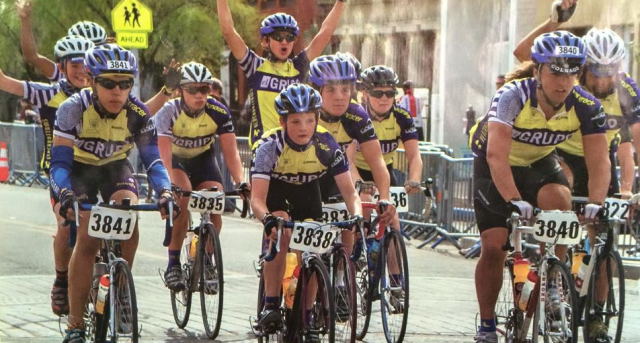
Seventeen members of El Grupo, a Tucson-based youth cycling organization, qualified for the 2015 USA Cycling Elite Amateur National Championships. It is the first time El Grupo athletes have qualified to compete in the National Championships.
The League of American Bicyclists has released its latest ranking of Bicycle Friendly States. In the eighth annual assessment, Arizona ranked 19th nationally, slipping from 15th last year. Visit bikeleague.org/states to see how all the states ranked and individual states’ report card with more details. Here is a direct link to Arizona’s report card BFS2015_Arizona.pdf The Bicycle Friendly States ranking is based on a number of key indicators, including infrastructure and funding that provide on-the-ground bicycle facilities; education and encourage programs that promote cycling; and passage and enforcement of bicycle-friendly laws that make it safe and comfortable for people of all ages to ride.
Despite ranking 19th; Arizona has a high percentage of population living in in Bicycle Friendly Communities; see here for more about cities and towns in Arizona that are ranked bicycle friendly.
…
The Tucson-Pima County Bicycle Advisory Committee recently sent a letter to the Pima County Department of Transportation Director, Priscilla S. Cornelio, outlining areas of concern regarding a “dangerous” road in Green Valley; Camino de la Canoa near White House Road. The letter recommended lower speed limits, additional signs, and a bicycle lane.
The Coconino County Board of Supervisors recently approved a resolution to designate five stretches of county-owned road as part of an official cross-country network of bicycling routes.
The United States Bicycle Route System is a developing network of interstate long-distance cycling routes in the United States. The system utilizes multiple types of bicycling infrastructure, including off-road paths, bicycle lanes, and low-traffic roads. The USBRS is the bicycle equivalent to the system of United States Numbered Highways. Envisioned to traverse the entire country, the USBRS is analogous to other national cycling route networks such as the Dutch LF-routes, the United Kingdom’s National Cycle Network, and is as comprehensive as the international EuroVelo network that spans Europe.
The Coalition is assisting the Arizona Office of Tourism to raise awareness of AZ bicycling opportunites and increase bicycle-related tourism in our state and we need your help.
The Arizona Office of Tourism is working on a description of the bike route from the Grand Canyon to Phoenix (via Flagstaff, Sedona, Cottonwood, Jerome, Prescott, Wickenburg, etc.). They are looking for photos of either cycling or notable sites/scenery.
Please submit any photos that you have taken to illustrate bicycling in Arizona along this route. Please either email us photos, or submit on our facebook page; this article will be posted on facebook. Photographers will receive photo credit if used by AOT.
The city of Yuma recently adopted sweeping reforms to regulate the operation of bicycles on sidewalks within the city. The subject of legal operation of bicyclists on sidewalks is nearly undefined in state law, and as a result varies dramatically from city to city. Just a tiny sample: Tuscon is generally not allowed at all, in Phoenix it is generally allowed unless prohibited by sign, in Tempe it is generally allowed unless prohibited by sign but stipulates only in the same direction as adjacent traffic flow. Continue reading New Yuma Sidewalk Ordinance
Actually, we should have said: riders of bicycles are not bound by rules that apply only to drivers of motor vehicles…
It’s helpful to note that the “rules of the road” apply not to vehicles, or bikes, but rather to the people operating these things. A typical example is the rule for what to do at a stop sign, §28-855(B). “A driver of a vehicle approaching a stop sign shall stop…”.
In Arizona, bicycles are, by definition, not vehicles; nor are they motor vehicles. Here are those definitions §28-101:
§28-101. Definitions
...
58. "Vehicle" means a device in, on or by which a person or property is or may
be transported or drawn on a public highway, excluding devices moved by human power
or used exclusively on stationary rails or tracks.
33. "Motor vehicle":
(a) Means either:
   (i) A self-propelled vehicle.
   (ii) For the purposes of the laws relating to the imposition of a tax on motor
   vehicle fuel, a vehicle that is operated on the highways of this state and
   that is propelled by the use of motor vehicle fuel.
(b) Does not include a motorized wheelchair, an electric personal assistive mobility
device or a motorized skateboard...
So, if a bicycle is not a vehicle, why does a cyclist have to stop at stop signs? Simple, because of a law helpfully titled Applicability of traffic laws to bicycle riders, §28-812,
§28-812. Applicability of traffic laws to bicycle riders
A person riding a bicycle on a roadway or on a shoulder adjoining a roadway is
granted all of the rights and is subject to all of the duties applicable to the
driver of a vehicle by this chapter and chapters 4 and 5 of this title, except
special rules in this article and except provisions of this chapter and chapter
4 and 5 of this title that by their nature can have no application.
This is a cyclist’s fundamental right to the road; the equal of driver’s.
Note well that it refers specifically to the rights and duties of the driver of vehicle — and NOT the driver of MOTOR vehicle, in fact the word motor does not appear at all in 28-812.
It might surprise you to note that the phrase “motor vehicle” occurs only a handful of places in ARS Title 28, Transportation, with respect to how a driver must operate a vehicle. By far, most driver’s duties refer, as in the stop sign example above, simply to vehicle.
Some references are incidental; lane and speed restrictions on motor vehicles weighing over 26,000 pounds (§28-736, §28-709). Another was intended to set minimum passing clearance when a motor vehicle overtakes a bicycle (§28-735). Two germane examples for cyclists are following distance, and impeding traffic.
§28-730, “The driver of a motor vehicle shall not follow another vehicle more closely than is reasonable and prudent…”, without the word motor in this statute, pacelining would likely be illegal. Since reasonable people would probably agree that a couple of inches is an inappropriately small following distance.
§28-704(A), “A person shall not drive a motor vehicle at such a slow speed as to impede or block the normal and reasonable movement of traffic…”. This is what I refer to as the cyclist’s second most fundamental right to the road, because if this statute were to apply to cyclists, then they would in effect be not allowed to use any road where traffic even might be impeded; regardless of number of lanes, width, presence or absence of a bike lane, or anything else. There is some detailed minutia [see footnote 2, here] revolving around what is meant by the “normal and reasonable movement” but that is immaterial to cyclists, since this section is inapplicable to them.
Likewise, §28-701(E) “A person shall not drive a MOTOR vehicle at a speed that is less than the speed that is reasonable and prudent under existing conditions”, never applies to bicyclists.
The point is that the phrase motor vehicle is used sparingly and deliberately to apply only to drivers of that type of vehicle, reflecting clear legislative intent. In the case of 28-704(A) to allow cyclists to use all roads even though motorists might sometimes be impeded (with some caveats: There is a specific allowance for prohibiting bicycles on controlled access highways, and other roads on a case-by-case basis). And the purpose of these laws is so that bicyclists can ride both legally and safely in the road according to best practices.
this is one of an occasional series on laws governing bicycle use in Arizona
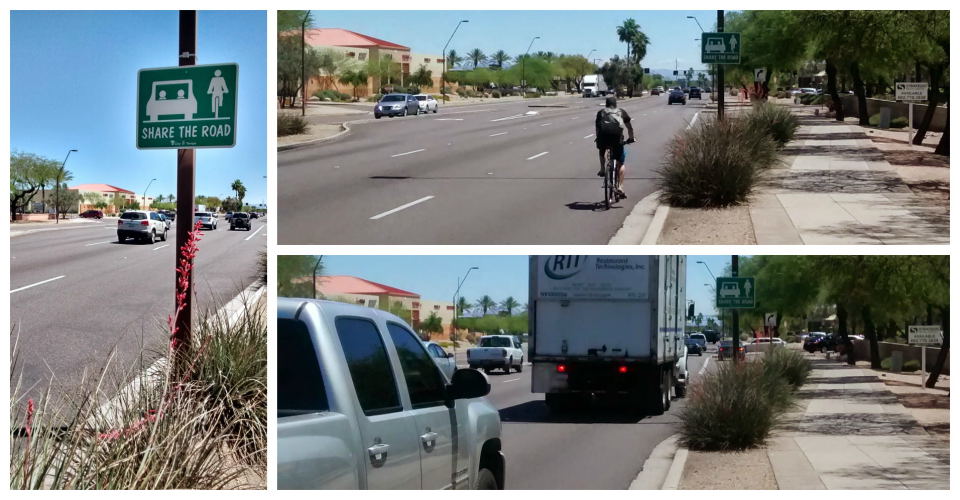
Elliot Road, eastbound east of Priest Drive, City of Tempe. Sign placed by the city reminds users to “Share the Road”. Posted speed limit 45mph. Even the fastest bicyclists will be traveling well below the posted speed limit. This arterial, like most, has lanes which are “too narrow to share safely side by side”, and as such, cyclists going straight ahead are advised to ride near the center of the right-most through lane. Motorists wishing to overtake must change lanes (at least partially) to pass legally and safely.
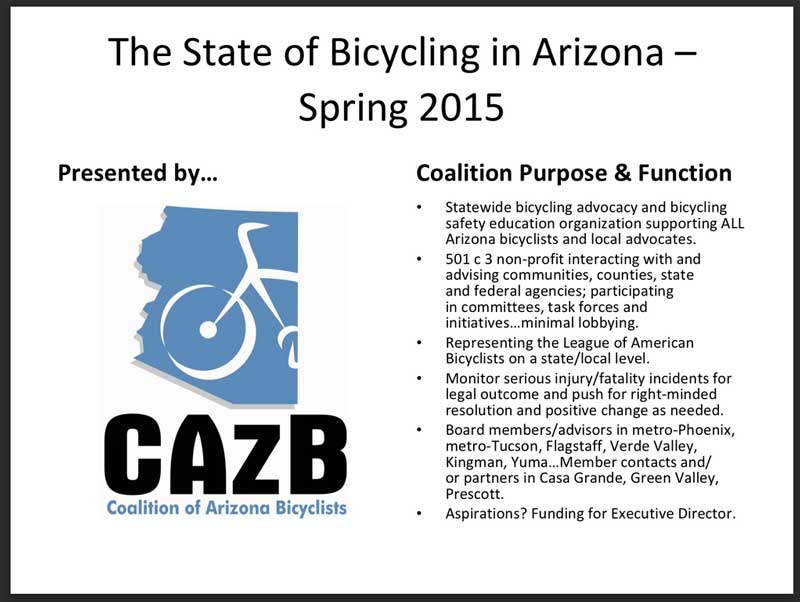
This presentation is a general overview of bicycling, suitable for general audiences, and was prepared and presented by Coalition President Bob Beane to the Phoenix Rotary on Wednesday 4/8/2015. View the presentation on drive.
April is Valley Bike Month in Arizona (National bike month is May; it gets HOT here!)…
For events the Valley of the Sun / Phoenix Metro Area… for a good calendar listing check out Valley Metro’s Bike Month page; or go straight to the events.


 The Bicycle Friendly States ranking is based on a number of key indicators, including infrastructure and funding that provide on-the-ground bicycle facilities; education and encourage programs that promote cycling; and passage and enforcement of bicycle-friendly laws that make it safe and comfortable for people of all ages to ride.