Complete Streets Presentation — May 18th

[Although no RSVP is required for attendance, RSVPs would be appreciated to: Michael Sanders, ADOT Bicycle and Pedestrian Coordinator, MSanders@azdot.gov; 602-712-8141 or Michael Colety, mike.colety@kimley-horn.com; 602-944-5500]

You are invited to an Overview Presentation on Complete Streets, Monday, May 18, 2009, 2:30 PM – 4:30 PM, ASU Phoenix Urban Research Laboratory, 234 North Central Avenue, 8th Floor, Phoenix. Presentation will be by national expert, John LaPlante, P.E., PTOE, National Complete Streets CoalitionView Flyer
Complete Streets are planned, designed, and operated to enable safe access for all users. Pedestrians, bicyclists, motorists, and transit riders of all ages and abilities should be able to safely travel along and across any street.
This Overview Presentation will provide a background on the benefits of Complete Streets, dispel myths, explain how existing streets can easily be retrofitted into Complete Streets, and detail how a Complete Streets policy can even save you money. This presentation is appropriate for elected officials, transportation agency leaders, transportation and land use planners, traffic engineers, roadway designers, planning and engineering consultants, transit providers, pedestrian and bicycle advocates, health service and older adult providers, and any others who are interested. This Presentation is funded through a grant from the Governors Office of Highway Safety to the Arizona Department of Transportation in coordination with the Maricopa Association of Governments and Arizona State University. One of the Top Priorities identified at the Arizona Transportation Authorization Summit was “Pursue smart growth policies” including “emphasize complete streets”.


BACKGROUND INFO ON “Complete Streets”:

In addition to the Arizona Transportation Authorization Summit mentioned above, discussion is occurring at ADOT Framework Policy Committee meetings ( and here).
“Framework Studies” (http://www.bqaz.gov/) are precursor to the update of our long-range statewide transportation plan.
And the Complete Streets Act of 2009 has been introduced into the US Senate and House, plus the “Sense of Congress regarding use of complete streets design techniques” was included in PL 110-140 Energy Independence and Security Act of 2007 (refer to Subtitle D – Highways SEC. 1133 )

CALTRANS has now adopted State DOT policy.
Locally, City of Scottsdale has adopted policy.
Some technical background on Complete Streets from our presenter, Mr. LaPlante.

Michael Sanders
Bicycle and Pedestrian Coordinator
Multimodal Planning Division
Arizona Department of Transportation

Cycling and Vehicle Doors / Trolley Tracks

The following information was prepared by Tucson attorney Eric Post:

In Arizona, anyone who opens the door to a vehicle has the duty to make sure it is safe to do so. This is by statute in the Arizona Revised Statutes as follows:

28-905. Opening vehicle door
A person shall not open a door on a motor vehicle unless it is reasonably safe to do so and can be done without interfering with the movement of other traffic. A person shall not leave a door open on a side of a motor vehicle exposed to moving traffic for a period of time longer than necessary to load or unload a passenger.

Unfortunately, there is a common perception that people on the roadway should watch out for parked vehicles and combined with the well known American love for our automobiles, this results often in motorists blaming the cyclist for hitting the door when the motorist opens it after parking.

The cyclist often does not have the ability to see if there is a driver or passenger in a parked car. Tinted glass, light reflections, and lighting conditions all work to obscure vision into the vehicle while riding. Further, the cyclist must look for road hazards including debris, glass, potholes, and whether or not the lane is free to move into for adequate clearance. As such, the law placing the duty on the door opening person is appropriate.

There are certain situations where a bike lane, or a route with striped shoulder will parallel an area of vehicles parked on the side of the road. This places the cyclist in a zone of danger. To be safe, the bike lane / route should be at least 3 feet from the parked vehicles.

In the common event that a cyclist must take evasive action to avoid a door swinging open, there has to be a good solid roadway to the cyclist’s left to allow the diversion.

In the situation of 6th Avenue in Tucson just South of Congress, the bike shoulder is in the zone of danger, however, there is a lane to the left that may be passable depending on traffic.

In the situation of the proposed trolley tracks on 4th Avenue just North of the downtown area, the bike route that is in the zone of danger is bordered on the left with trolly tracks and the cyclist cannot safely perform an evasive maneuver.

Bicycle wheels on trolley tracks require a near 90 degree crossing or the front tire may easily slide along the metal and cause a catastrophic loss of control.

Therefore, it is my opinion that cyclists should not be placed in a danger zone where they have the trolley and the tracks to the left and vehicle doors to the right. This is unsafe and similar to Russian Roulette in that sooner or later, an injury will occur.

I do not recommend banning cycling on such roadways. A cyclist is a legitimate road user with the same right to the road as the driver of a vehicle under A.R.S. 28-812.

The solutions would be to ban parking completely because parking vehicles do not necessarily have a right to the roadway. Also, post signs reminding drivers of their responsibilities (including rear seat passengers who have a door), or relocating the bike route, or relocating the trolley tracks. Regardless of what solution is chosen, it must be a good working solution.

In the future, it is important to design roadways in such a manner as to not create a hazard for cyclists and non-motorized traffic.

There is a Federal statute that requires the preservation of safety of non-motorized traffic on our roadways.

23 U.S.C. 109 (m) Protection of Nonmotorized Transportation Traffic. –The Secretary shall not approve any project or take any regulatory action under this title that will result in the severance of an existing major route or have significant adverse impact on the safety for nonmotorized transportation traffic and light motorcycles, unless such project or regulatory action provides for a reasonable alternate route or such a route exists.

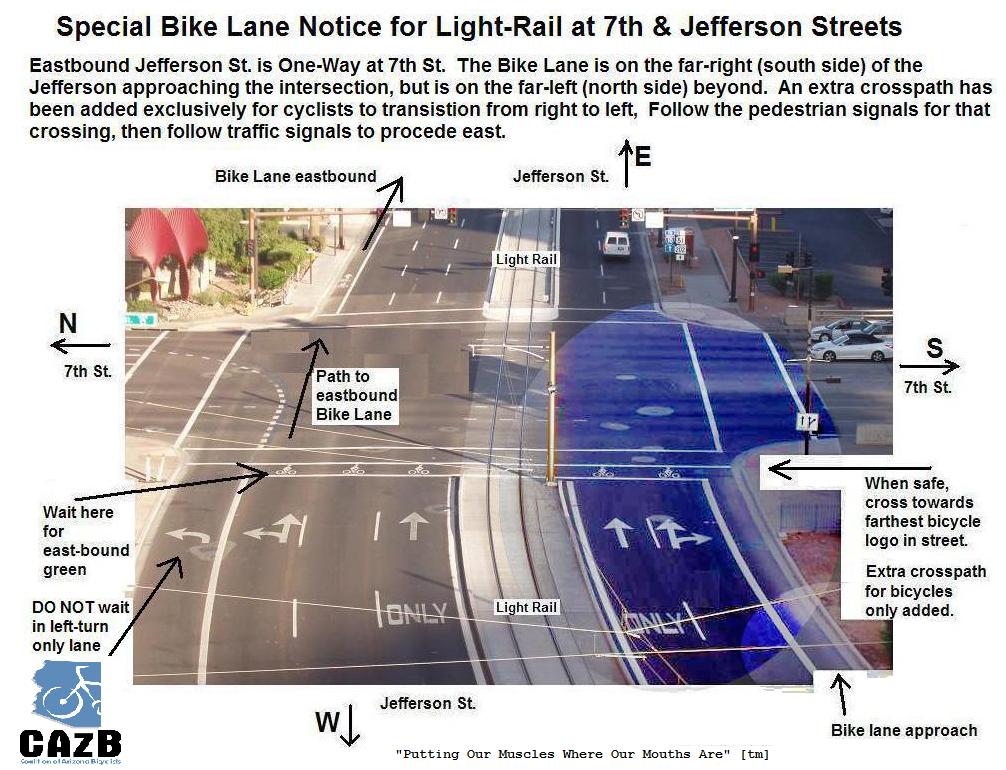
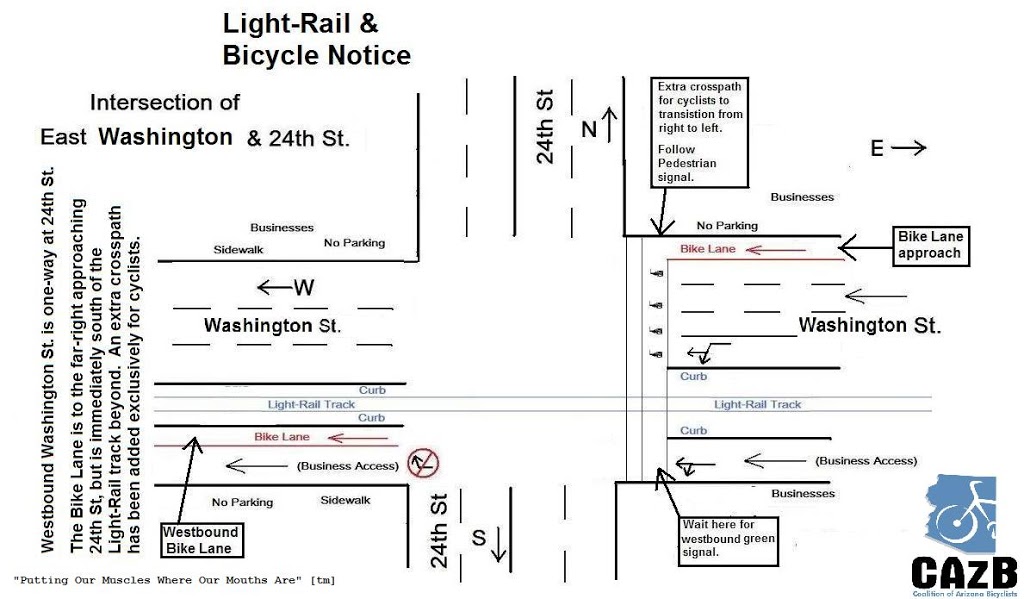
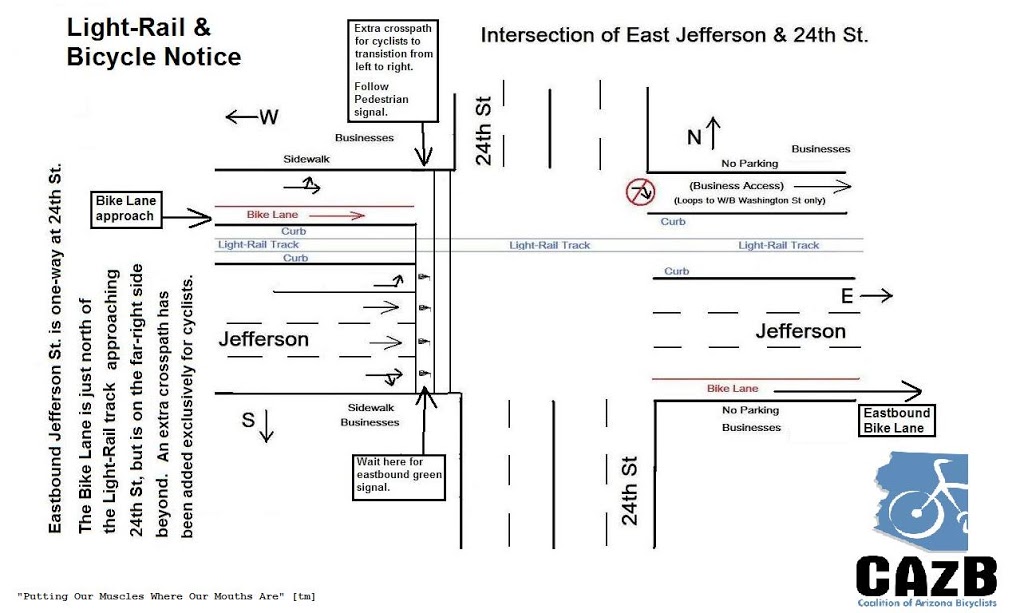
Bike Lanes and Light Rail 7th to 24th Streets along Washington & Jefferson Streets.

Many more photos here.

The following is an email thread of discussion of the work the City of Phoenix is doing for cyclists on the subject issues.

Bob & Bill:

Below is the response from Mike Cynecki, the City traffic Engineer doing the rework. As you can see, they are making it better, albeit slower than we want. Contrary to what I said is that the 9th St intersection is recognized to be fixed. Richard Moeur suggested a block of shared lane (both sides) along the business / bike roadway, to give a cyclist plenty of leeway as to when to try to move to the right. I like that more than another bike box that I suggested. Richard also suggested a good consultant.

What I’m saying is that the City is recognizing the problems and is helping. A total rebuild is not going to happen and antagonizing our friends is going to hurt us. We have a city budget crisis now and future light-rail expansions are coming. They are receptive now to our inputs. Keeping involved and offering reasonable suggestions are our best path.

A week ago, I was informed by a cyclist that there is another L-R vs. bike lane area that needs to be looked at. This is between Priest and theTempe Town Lake crossing. Haven’t had a chance to look there yet.

Gene

“Putting my muscles where my mouth is.” [tm]

Radar has written that bike lanes be eliminated and that shared lane markings be use in the right-most motor vehicle lane. I replied:

Use of shared lane markings, while established in some localities, have the same “unfamiliarity” factor as bike boxes in Arizona. Use of either will require education and compliance by cyclists and motorists alike. Trying shared lane markings in an area that was specifically designed for speedy high-volume motor traffic would harm more than help. Further, ARS 28-735 exempts motor vehicle drivers from the penalties when an injury occurs where there is a nearby bike lane. That would not be good. I don’t want the introduction of shared lanes to occur in such a motorist-favored area as Jefferson St. between 7th St. and 24th St. I believe we do not want to force good, but less trained cyclists to abandon a good place to ride, namely the business access/bike lanes on the left sides of the tracks. These people will be dis-enfranchised rather than ride in the “slot-car” lanes where the shared-lane markings would be.

Bob wrote:

As far as I’m concerned, the whole section of Washington/Jefferson from 7th Street to 24th Street, should have condemnation proceedings lodged against it and removed from any semblence of bikeability in the metro area. The whole section is an abortion in my opinion and should be ripped out and put together correctly (as if that would actually happen), and the all seeing, all knowing engineers that “engineered” this project should be reprimanded and sent for re-education as to what constitutes Bicycle Friendly facilities. I realize that there are some that did not approve of this finished project, but they are in the minority and constitute little political clout. In the meantime, I and many others will avoid the downtown area on our bikes until this exercise in stupidity is rectified! Bob.

— On Tue, 12/30/08, Mike Cynecki wrote:

> Subject: Re: 9th St & Jefferson St Bike Lane configuration.
> To: geneh@cazbike.org
> Date: Tuesday, December 30, 2008, 12:15 PM
> Gene – You make a good point and we have not forgotten about
> this issue .
> . . or the lack of bike detection along the frontage road at some of the
> signals. Richard Moeur had suggested we retain a good bike consultant to
> look at this issue and others along the LRT line and give
> us some recommendations. However, with our horrible budget
> situation, it takes away our ability to react quickly. One of the things we
> are working on is getting as-built paint plans to see exactly what was
> installed, and we will be seeking suggestions for alternate designs.
> Richard suggested that
> we designate a shared vehicle/bike frontage road for about 500 feet east
> of 9th St before designating the right side for bicyclists to allow for a
> larger merge area.
>
> I am a bit hesitant to install yet another bike box when we just asked the
> Feds permission (after the fact) to experiment with the three we already
> installed. However, it will still remain an option. Bike boxes are
> supposed to be at traffic signals. It may also be wise to extend the
> bike lane for a block and then (without a bike box) have the conversion
> over to the right side of the frontage road.
>
> Mike Cynecki
> Traffic Engineering Supervisor
> Street Transp. Dept.
>
> All:
>
> Since the Bike Lane issue vis-a`-vis Light Rail tracks and motor vehicle
> lanes has been an issue, one aspect has been lost. Lots has been said
> about the Bike Boxes now in place at 7th & 24th Streets at Washington &
> Jefferson Streets. This discussion has involved the proper use and
> designation of a bike box and the related knowledge and skills of
> motorists and cyclists alike, along with what education of each might
> actually occur. However, an actual safety issue exists at 9th St.
>
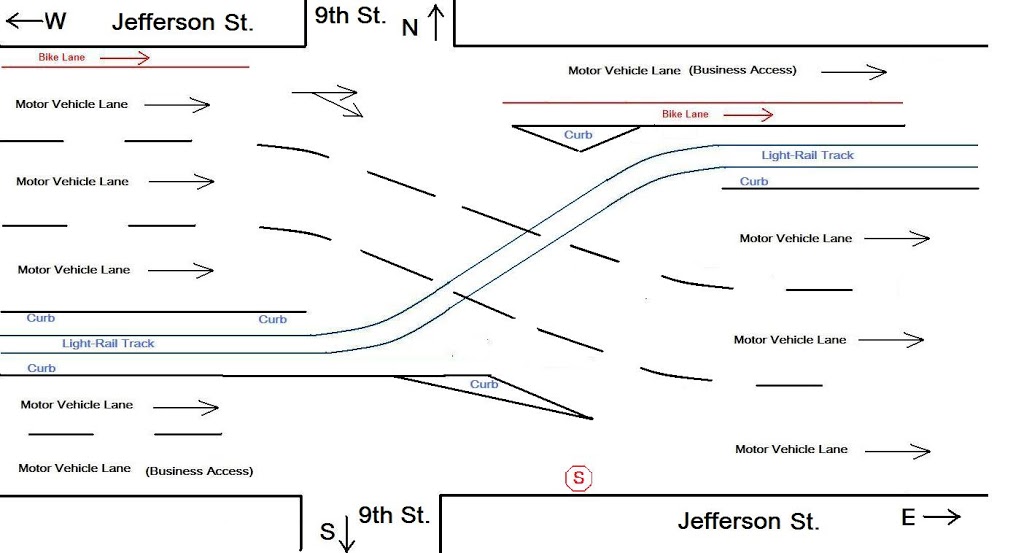
> Please see the attached diagram. A cyclist following the eastbound bike
> lane approaches this intersection on the far-left (north side of
> Jefferson). The bike lane continues beyond 9th St. adjacent to the
> light-rail tracks, as part of the business access / bike lanes.
> Unfortunately this involves another crossover of bicycle and motor vehicle
> paths. The crossover occurs within the intersection. Since a car
> approaching in the left m-v lane MAY proceed straight (and will not be
> signaling), the cyclist is risking a rear-end collision when attempting to
> cross to the continuing bike lane.
>
> During the on-site ride several weeks ago, traffic engineers that are also
> cyclists recognized that the decision time for a cyclist would actually
> occur before the car has visually indicated a turn or straight maneuver.
> Not a good situation should the cyclist guess wrong, even after using the
> skills we teach in our classes.
>
> Fortunately, I have a simple solution. That is, continue the bike lane on
> the far-left of the business access lane for another block to the east.
> Then provide a bike box for the cyclist to cross over when there is no
> ambiguity of what a motor vehicle would be doing.
>
> Gene


Bikes on light rail

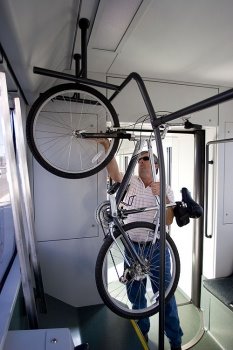
… light-rail trains contain hooks on the ceiling inside the cars. Bikers must hang their bikes vertically inside a car rather than load their bikes on the front exterior the way they do on a bus.

Rich Rumer, chairman of the Arizona Coalition of Bicyclists, said most cyclists he has talked to like the idea of bringing their bikes on the train. “The bike community as a whole is excited about it because it’s an intermodal thing, and that should be the goal,” he said.

Loading bike on train requires feat of strengh, The Arizona Republic, Dec 27, 2008

Light Rail Grand Opening Celebration


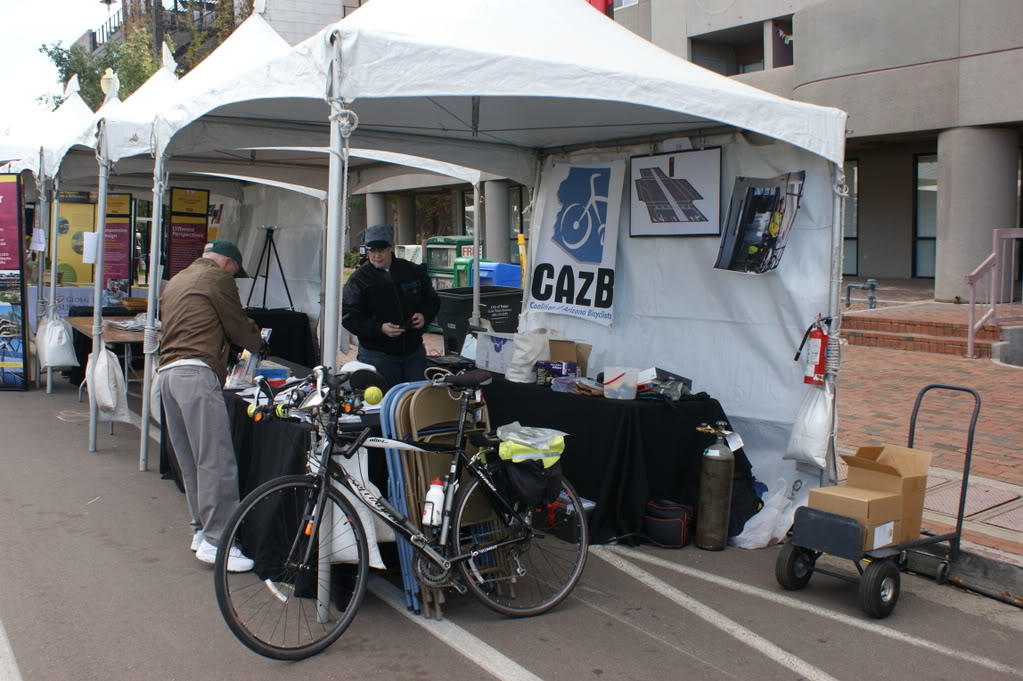
The Coalition exhibited at Metro Light Rail’s Grand Opening Celebration.

The booth was in Tempe on Opening Day, December 27, at Veteran’s Way & College Ave.) from 10AM to 5PM.

More photos from grand opening here.

Cycling and Light-Rail go hand-in-hand since each extends the destination horizons of the other. So whether you are primarily a Light-Rail / Bus rider or primarily a cyclist, you can benefit from using both. We are asking for volunteers to staff the booth. You will be answering questions about bicycles on L-R vehicles and handing out safety fliers. If we have enough volunteers, we may have a second booth at the “Green Scene” in Tempe as well. Please contact cazbike@gmail.com if you can help.

L-R rides are free Saturday Dec 27 thru Wednesday, Dec 31 so you can help a couple hours and still have plenty of opportunity to “Ride the Rails” in smooth, quiet comfort with your (optional) bicycle on the rack (video demo).

And don’t forget to review the safety considerations of operating around the Light rail.

CAzBike 2008 Year in Review

For nearly twenty years CAzBike has been YOUR advocacy and education resource in Arizona. Made up of hundreds of individual and family members, as well as many supporting businesses and clubs, we have represented you across the state and nation.
Our advocates have represented Arizona Arizona at the Bike Education Conference in Austin Texas, The National Bike Summit in Washington DC, and The Pro Bike/Pro Walk symposium in Seattle Washington. Within Arizona our advocates have served….read the rest in .pdf

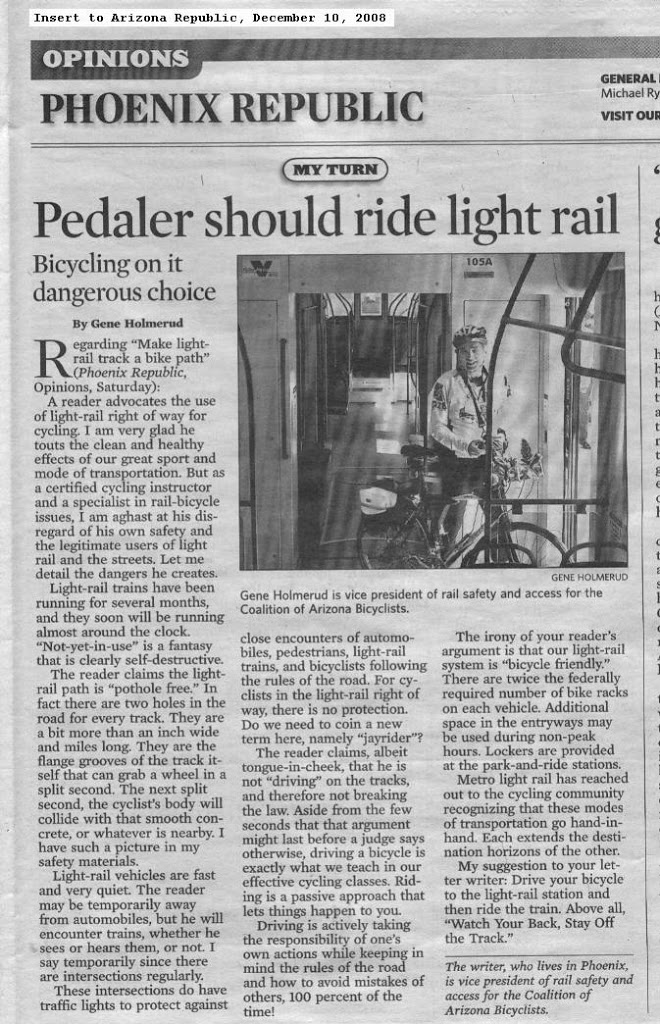
Pedaler should ride light rail: Bicycling on it is a danergous choice

The following guest editorial published Dec 10, 2008 Arizona (Phoenix) Republic was in reply to a “Letter to the Editor” (see comments for original letter).

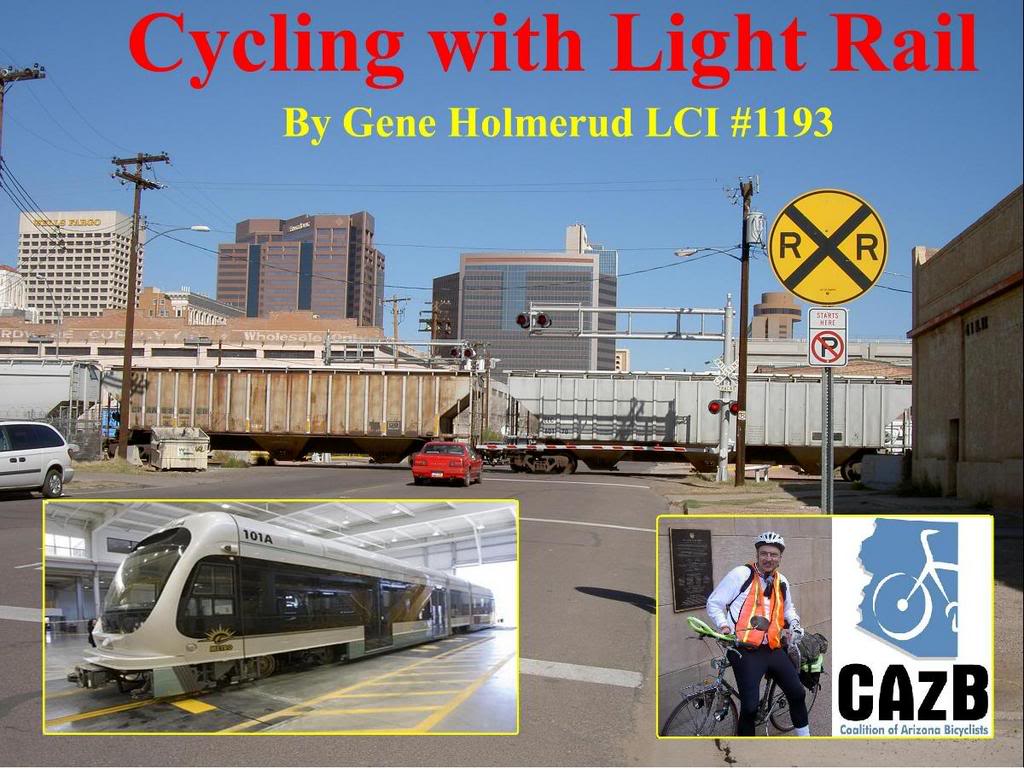
Mr. Wilson advocates the use of Light-Rail Right-of-Way for cycling. I am very glad he touts the clean and healthy effects of our great sport and mode of transportation. As a League Cycling Instructor and a specialist in rail-bicycle issues, I am aghast at his disregard of his own safety and the legitimate users of Light-Rail (L-R) and the streets. Let me detail the dangers he creates.
L-R trains have been running in our streets for over a year now and will soon be running almost around the clock. “Not-yet-in-use” is a fantasy that is clearly self-destructive to one’s life.
“Pothole free” is one of his claims. In fact there are two holes in the road for every track. They are a bit more than an inch wide and miles long. They are the flange groves of the track itself that can grab a wheel in a split second. The next split second, the cyclist’s body will collide with that smooth concrete, or whatever is nearby. I have such a picture in my safety materials.
L-R vehicles are fast and very quiet. Mr. Wilson may be temporarily away from automobiles, but he will encounter trains, whether he sees or hears them, or not. I say temporarily since there are intersections regularly. These intersections do have traffic lights to protect against close encounters of automobiles, pedestrians, L-R trains, and bicyclists following the rules of the road. For cyclists in the L-R Right-of-Way, there is no protection. Do we need to coin a new term here, namely Jay-rider?
Mr. Wilson claims, albeit tongue-in-cheek, that he is not “driving” on the tracks, and therefore not breaking the law. Aside from the few seconds that that argument might last before a judge says otherwise, driving a bicycle is exactly what we teach in our effective cycling classes. Riding is a passive approach that lets things happen to you. Driving is actively taking the responsibility of one’s own actions while keeping in mind the rules of the road and how to anticipate and avoid mistakes of others, 100% of the time!
The irony of this argument is that our L-R system is “Bicycle Friendly”. There are twice the Federally required number of bike racks on each vehicle. Additional space in the entryways may be used during non-peak hours. Lockers are provided at the park-and-ride stations. Metro Light-Rail has reached out to the cycling community recognizing that these modes of transportation go hand-in-hand. Each extends the destination horizons of the other.
My suggestion to Mr. Wilson: Drive your bicycle to the L-R station, then ride the train. Above all, “Watch Your Back, Keep Off the Track”.

Gene Holmerud
PE (AZ, Electrical, retired)
Rails-to-Trails Member #6246510
League Cycling Instructor #1193
Vice-President for Rail Safety and Access, Coalition of Arizona Bicyclists
Operation Lifesaver Presenter

Membership Meeting: Nov 17

The next Coalition Membership Meeting will be at 7PM at the Veterans Hospital (7th ST & Indian School Rd.). We wil meet in the ACC (Ambulatory Conference Center) conference room in the basement. Location

FEATURED SPEAKER:

Have you tried to ride your bicycle to a bus stop, then watch an arriving bus that already has the bicycle rack full? Are you anticipating using Light-Rail and fine that all 12 racks on a train are used, or are not confident on lifting your bicycle to the wheel hook near the cieling? If yes, LCI and Coalition board member Sharon Newman-Matt has a solution: A FOLDING bicycle. She will demonstrate and answer questions during the program.

Please join us. Munchies and drinks will be provided.