

Remember, April is Valley Bike Month; visit Valley Metro’s bike month homepage.
And, Tucson-area residents — you can win a bike by participating in the 2011 Commuter Challenge at tucsonaz.gov going on the month of April.
Remember, April is Valley Bike Month; visit Valley Metro’s bike month homepage.
And, Tucson-area residents — you can win a bike by participating in the 2011 Commuter Challenge at tucsonaz.gov going on the month of April.

Coalition representative Bill Lazenby reports that on March 24 the SRTS Review Committee met and the following projects were approved. For more info about SRTS, visit saferoutesinfo.org.
Infrastructure Projects
1. City of Apache Junction–Safe Bicycle/Ped Routes ——— $399,598.
2. Pima County–Coronado Cougars–Walkway/Bike path —- $399,382.
3. Town of Springerville–Round Valley in Motion ————– $399,728.
4. City of Tucson—Liberty Ave School —————————- $399,880.
5. Yuma Proving Grounds–Price Elementary School ————-$104,904.
6. Apache County–St Johns SRTS———————————– $327,600.
7. City of Flagstaff–Pine Knoll FUTS / Bike Lanes————— $385,128.
8. City of Tucson-Gila Panthers Tracks —————————– $352,177.
The next step is for Brian Fellows to present these approved applications to the State Transportation Board this summer and the monies will be available for the projects by the start of school in September,2011.
Cycle # 6 will start by September and all applications need to be into Brian at ADOT by December 31, 2011

Get ready for a new bike festival on April 23rd at Steele Indian School Park in downtown Phoenix, the SanTan Wheelie Jam. EVERYONE should be there, and bring all your friends too.
This is an all local festival, local bike groups, local beer (SanTan brewing), local food, local bands, local bike shops. TBAG is getting it going, and all beer sales proceeds will go to Phoenix groups.
Event info on facebook.
More info at T.B.A.G.
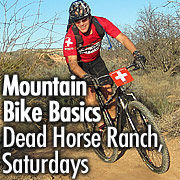
Dead Horse Ranch State Park offers Saturday Mountain Bike Rides / Sunday Hikes
 |
| Ranger Randy Victory. Mountain bike rides will include talks on Maintenance, Bicycle Physics, Turning/Braking, Climbing, Descending, and Riding in Groups. |
Beginning Saturday, March 26th and going on until Sunday, May 8th, Park Rangers at Dead Horse Ranch State Park (directions) in Cottonwood will offer guided mountain bike rides on Saturdays and ranger-led hikes on Sundays. The hikes & rides are free, however the regular entrance fees to the park will apply. Annual Passes will also be honored.
“Mountain Bike Basics” will take place every Saturday afternoon at 2:00, and go until 4:00, “or when everyone gets tired”, according to Park Ranger Randy Victory. “These will be beginner trail rides on the dirt, with a little instruction on the pavement.” Victory, a certified cycling instructor, will offer everything from basic riding techniques to trail etiquette.
Although the rides are oriented towards beginners, everyone is welcome to attend (minimum age is 15). “There’s always a certain amount of interaction between riders,” explains Victory. “Group rides where the beginners are supportive of each other, and more experienced riders can offer their insight are an excellent way to build skills, and have a great time doing it. The focus is on fun!” Riders will be REQUIRED to wear a helmet and complete an acknowledgment of risk form (parents must sign for riders under 18 years old). They should also bring water and make sure their bike is in good working order. Riding gloves are recommended. The rides will start at the Raptor Trailhead at the top of Roadrunner Road at the park.
“Nature Walks” will start on Sunday mornings at 9:00 am, and last for 1-2 hours. The guided hikes will meander along riparian areas or stroll through the high desert trails within the park. Hikers need to bring plenty of water, sunscreen and wear appropriate clothing; sturdy shoes, a hat. Says hike leader Ranger Margie Sanchez, “You might want to bring binoculars and a camera, too. These hikes are a great opportunity for wildlife sightings and photo ops.” Most hikes start at the Quail Loop Campground – inquire at the gate for starting points.
Anyone is welcome to show up for the hikes & rides at the park. The day use fee is $7.00, or an Annual Pass can be used. For more information, call Dead Horse Ranch State Park at 928-634-5283. You can also email Ranger Victory at rvictory@azstateparks.gov or Ranger Sanchez a msanchez@azstateparks.gov with questions.
.

Thanks to all those who came out and participated in the 13th annual CAzBike Swap Meet that was held last Saturday at the Phoenix Municipal Stadium. The weather was great, a picture-perfect mid-March Arizona morning. About 100 vendors, and several hundred swappers came out to find a great deal on bikes, parts, and anything else. The Coalition sponsors the event as a service to the bicycling community;
there are no fees for buyers or sellers. The event was organized, manned, and run by Bob Jensen and Peter Mather — thanks guys for a great meet! Hope to see you in 2012. Be sure and sign up on our email list in order to receive annoucements for future events.


The 13th Annual Coalition of Arizona Bicyclists bike swap meet is going to be held Saturday March 12, 2011, 7AM – Noon, in the Phoenix Municipal Stadium parking lot.
The Bicycle Swap Meet will be a bargain hunter’s paradise. This huge bike garage sale will have great deals on all types and sizes. The swap meet is FREE for buyers and sellers.
For more information please contact Bob or Peter (see flyer).
Link to .pdf for printing.

The League of American Bicyclists, in the January/February 2011 issue of American Bicyclist, specifically recognized Gilbert, AZ, for implementing a transportation policy requiring bicycle lanes on ALL arterial streets. The LAB also recognized Pima County for its Diversion/education program for ticketed bicyclists (including a
reference to our very own board member, Sheila Foraker, who is the Pima County Bike Ambassador Project Manager).
In addition, the January/February issue listed Arizona as 9th in the ranking of bicycle friendly states and listed the following as our Bicycle Friendly Communities:
Listed among Bicycle Friendly Businesses were TriSports.com of Tucson and Banner Health of Mesa.
by Bill Adamson, Co-Chair, Santa Cruz Valley Bicycle Advocate Committee

BACKGROUND
About six years ago our group of local bicyclists from the Santa Cruz Valley area concluded that cycling was becoming less pleasant and significantly less safe along our popular bicycle routes. Increased traffic congestion coupled with significant gaps in the available network of bike lanes caused us serious concern. This lack of safe routes led us to write letters to our government officials, where we received no response,
and letters to the editor of the local newspaper to publicize this problem. Eventually, we sent a letter, signed by 50 cyclists from our community, to our County Supervisor requesting that the most dangerous gap of 0.7 miles in our bike lanes be filled.
Following the letter we requested and were granted a meeting with the County Supervisor with 50 cyclists in attendance to emphasize our seriousness. He brought a County DOT manager to the meeting who admitted we had been promised this gap would be closed but maintained the funding wasn’t available. They promised the County would look into this and meet with us again in a month to report what could be done. Our group formed a committee, now known as the SCVBAC, and continued to meet monthly with the County DOT Engineering Manager and Project Manager. Preliminary plans were developed for review, but funding continued to be an issue. A lower cost solution was discussed, found mutually acceptable, and in 3 months the funding was made available. The project was a go! We continued to meet monthly to review and discuss progress. This key bike lane connection was completed in September, 2004, just 9 months after our meeting with the County Supervisor. This initial success was the beginning of a mutually satisfactory, cooperative relationship for safer bicycling between the SCVBAC, the County Supervisor, and DOT that continues today.
LESSONS LEARNED

WHAT’S NEXT
Our great initial success was recognized by our local Green Valley Council who requested that we become a sub-committee of the Council and develop a master plan for future planning. This was good since we needed to now go after other gap closures. We convened a meeting of bicyclists, and developed a list of gaps which were prioritized according to our perceived judgment of their safety concern based on our experience riding them. This formed the basis of our “Master Plan for Lanes and Trails”, approved by our community and published by the Council in 2005. The plan shows both the most urgent projects recommended for improved safety, and also a projection to what projects will be needed in the future with significant population increases. Our Master Plan is updated annually and can be viewed on our website, www.scvbac.org. You can also view the many projects that have been completed and those underway. We have had 1-4 projects completed every year, and this year there will be 5 projects completed.
This Master Plan is used to promote additional improvements in our community. It demonstrates that we have carefully thought about what we are currently promoting and how it fits in with other future projects.
SCVBAC BUILT ALLIANCES
Our Committee consists of bicyclists who are citizen volunteers that want to make a difference in our community. Most of us are retired and contribute our talents learned from years in careers and or hobbies. Some examples of how we have built alliances within our region are:
FUNDING
Yes, finding funding is a problem and you need your alliances in Govt. to help. They know more about various funding opportunities than you do. Until the recession hit the jurisdictions had funding available for public projects that you had to compete for. If your project was a needed one, and you and your alliances could sell it, then you got funded (again within reason). So you had to be careful to not get greedy. Only ask for what you think is fair and justifiable under the circumstances of the time.
We also applied for Transportation Enhancement Grants. We have won 3 so far. We usually draft the application with the guidance from our experienced Govt. Bike Advocate who then finalizes and promotes it thru the process.
We are fortunate that the County voters approved a Regional Transportation Authority in 2005 that collects ½ cent sales tax for funding transportation for 20 years. The bicycle and pedestrian projects are $60M over 20 years. This funding was not intended to replace the normal funding from the jurisdictions, but because of the recession, it is currently most of our funding.
ENCOURAGEMENT
We also encourage more people to ride their bike. Our website lists contacts for local rides and lists scheduled rides. We published a regional bike map showing our broad network of connected routes. In a little more than a year 9,000 copies have been distributed, and we are working on an update and reprint. Our local newspaper and Chamber of Commerce obtained sponsors and published the map based on our draft. We also provide support for local Senior Games, Bike to School, and Bike Week events.
SUCCESS
Our SCVBAC success has resulted in more people riding their bikes which has provided immense satisfaction for us advocates. We have found great support and cooperation from our Govt. agencies and community, and greatly improved cycling safety and enjoyment. I hope our success inspires other communities that do not have a bicycle advocacy group to form one.
You can find out more about SCVBAC at their website, www.scvbac.org .

by Bob Beane, President, Coalition of Arizona Bicyclists
As anyone knows who has crossed over from “simply” being a bicyclist to being a bicycling advocate, there are not enough hours in a day…The more you immerse yourself in this world, the more you find that needs to be done. Possibly, that’s one of the reasons for the high rate of burnout among advocates.
Personally, I’m not there, yet… But, I can see how it can happen. So, from time-to-time I tell myself that one of the CAzB’s biggest priorities should be to increase membership.
In particular, we could benefit from members who can support bicycling advocacy through volunteering time, contributing “above average” donations to fund programs and/or who have connections (political, corporate, large consituencies of a similar mindset, etc.). If you happen to be one of those folks, please contact us and ask the question: “How can I help?” If you know someone who fits that desription, we’d like to get to know him or her.
In the interim, here are are few activities that the CAzB has been or will be involved in in the recent past and future:
I could go on and on, but I’m pretty sure I’ve said enough to give you both a flavor for the opportunities that exist and how increasing the participation in bicycling advocacy opportunities might make a significant difference over time.
So, if you know of someone who is passionate about bicycling (or who commutes or just really enjoys riding), and who has realized that it is time to step up and make some level of contribution to making things better, please send them our way.
Thanks, please ride safely and share the road…