EVENT POSTPONED — Please bear with us while we make arrangements; the intention is to re-schedule to sometime Fall 2020. If you have already registered for the April event you will be notified via email.
CyclingSavvy offers traffic safety training that uses cutting-edge graphics and animations to help you best navigate any situation, you’ll learn how to recognize and avoid conflicts, making your ride as safe as possible, at the same time reducing stress.
The Coalition is now a CyclingSavvy Affiliate: you receive a 25% discount off the online Ride Awesome package. This is $25 off the usual price of $100.
The online CS Ride Awesome package has a 30-day money-back guarantee. CAzB will receive $10 after the 30-day money-back period has expired.
To sign up for the CAzB affiliate Cycle Savvy Ride Awesome Package
When checking out enter coupon code “CAZBIKE” and click the blue “Apply coupon” button
Click the blue “Proceed to checkout” button and follow the instructions
Please note; once you purchase access to the online course you can watch it as many times as you want, offering lifetime access to the current Basics and Masteryand future courses (that are offered to the public; excludes certification courses).
This year, the annual meeting will be held via tele-conference.
A business meeting and election of open board of directors seats will be held.
Tuesday, October 15 , 2019 at 6:30PM Arizona Time.
Members in good standing who wish to attend/listen/vote please contact cazbike@cazbike.org no later than 10/11 to obtain the phone in details. Not a member? Click here to join.
Jackie Martin attended the Spring 2019 National Bike Summit in Washington DC with partial financial support from the Coalition, below is her report:
Children’s cycling education: “Bunny Hop”
I wanted to extend a warm thank you for your financial support of my trip to present at National Bike Summit this year. The funds contributed by TBAG & CAzBike paid for my registration fee and accommodations. Since Ivan (my husband and TBAG board member) and I traveled together, we both bene
fited greatly from your generosity and wanted to say thank you, and share our experiences.
Here’s the presentation I gave. The panel I spoke on was called “Expanding Audiences,” and I discussed how TBAG worked to become more inclusive of families by offering children’s cycling education. I discussed the public health research I’ve conducted as a nurse, and the best practices I discovered for children’s cycling education. I then implemented those best practices in a TBAG-sponsored ride called Bunny Hop, which just celebrated it’s 3rd anniversary. My presentation at Bike Summit offered a detailed toolkit for implementing Bunny Hop, or something similar, in other communities. I am proud to say that about half a dozen other cities are committed to hosting a Bunny Hop in 2020!
“Lobby Day” at National Bike Summit 2019
Here’s a summary of some of the lectures Ivan and I attended. Probably the most interesting of the sessions we attended was the tour of Crystal City, hosted by Bike Arlington. I’ve included photos of some of Arlington County (VA)’s creative solutions to offering active transport options in preparation for Amazon.com opening a headquarters to Crystal City. Another interesting point is the last slide of the Summary, “general impressions.” The biggest take-away from the Summit is that the approach to bike advocacy – on the local and national level – is changing to focus on “active transit,” especially pedestrians. Another shift in the dialogue is focusing on environmental and economic health of communities that promote cycling (rather than previous public health approaches focusing on staying fit, reducing traffic, etc).
We learned a lot and are very grateful for the experience. If you have never been to Bike Summit, I urge you to consider going next year – it’s a wonderful learning and networking experience.
And just as an aside, I have been asked by the Arizona Nurses Association quarterly publication to author an abstract on my research and the Bunny Hop project, from a public health perspective. When I finish it, I’ll send this along, too!
After over a decade of waiting, Arizona will become one of the last US states to place general restrictions on handheld cell phone use. Yesterday the Arizona legislature passed HB2318 and Governor Ducey is expected to sign the bill which would require electronic gadgety to be operated hands-free only; with certain exceptions. Credit must be given to the victims and families of victims who have pursued these laws year-after-year; as well as to former state Senator Steve Farley, as well as Brendan Lyons, a victim and also founder of Look Save a Life , and anti-distraction advocacy organization.
Brendan Lyons (center) looks on as Gov. Ducey signs
The offense will be primary, and enforcement can commence immediately once signed (emergency status), there will be with a lengthy warning period until the beginning of 2021.
The death of Officer Townsend, killed at a traffic stop by a driver who said he was texting, earlier this year appears to be the straw that finally broke the camel’s back. [UPDATE June 2021 — although this remains true; all charges against that driver were dropped; follow the same link for explanation] The fact that as many as twenty seven localities in Arizona had one-by-one painstakingly instituted various ban beginning 12 years ago should cause Arizona legislators great shame in their failure to act sooner; allowing the problem to worsen, particularly after large upticks in fatal traffic crashes after 2012.
An additional bill that also narrowly passed the house yesterday, SB1141, which is a more general anti-distracted driving law. This bill, however, must go back to the Senate; so it’s fate is unclear.
Support the Coalition simply by shopping at Amazon! Simply visit our unique link https://smile.amazon.com/ch/86-0735762 to configure your amazon account to benefit the Coalition.
With AmazonSmile, Amazon donates 0.5% of the price of eligible smile.amazon.com purchases to the Coalition.
[be sure to see update, below] To: Cochise County Highway Department
Misleading sign
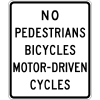
When riding Ramsey Canyon Road from Hwy 92 to the Nature Conservancy there is a sign 350 feet before the multi-use path from Stafford Ln to the multi-use path on the South side of Ramsey Canyon Road leading to the parking lot at Brown Canyon Ranch.
When riding my bike up to the Nature Conservancy, many motor vehicle drivers will point to the multi-use path, indicating that I need to use the multi-use path. I have, also, talked to several residents whose only access to their homes is from Ramsey Canyon Road. They tell me this sign means that cyclist “must” use the multi-use path. I inform them about ARS 28-812 “Applicability of traffic laws to bicycle riders.” Furthermore, I know of no Arizona or County statute which makes this sign enforceable regarding a cyclist “must” use the multi-use path.
This sign is commonly misinterpreted and leads to irritation between cyclist and motor vehicle drivers.
The Coalition of Arizona Bicyclists have suggested the following recommendations. Reword the sign to include “MAY” that is, “MAY USE MULTI-USE PATH.” Or replace this sign with a sign specified by the MUTCD 9B.18 “Bicycle Warning and Combined Bicycle/Pedestrian Signs (W11-1 and W11-15).
We believe the justification for this change is that users of the path should be expected in the road crossing. Thus, the current sign should be replaced with W11-15 and W11-15P signs and keep the “350 feet” W16-2P sign.
Here’s what MUTCD says about that sign:
W11-15 sign
Section 9B.18 Bicycle Warning and Combined Bicycle/Pedestrian Signs (W11-1 and W11-15)
Support:
01 The Bicycle Warning (W11-1) sign (see Figure 9B-3) alerts the road user to unexpected entries into the roadway by bicyclists, and other crossing activities that might cause conflicts. These conflicts might be relatively confined or might occur randomly over a segment of roadway.
Option:
02 The combined Bicycle/Pedestrian (W11-15) sign (see Figure 9B-3) may be used where both bicyclists and pedestrians might be crossing the roadway, such as at an intersection with a shared-use path. A TRAIL X-ING (W11-15P) supplemental plaque (see Figure 9B-3) may be mounted below the W11-15 sign.
03 A supplemental plaque with the legend AHEAD or XX FEET may be used with the Bicycle Warning or combined Bicycle/Pedestrian sign.
Guidance:
04 If used in advance of a specific crossing point, the Bicycle Warning or combined Bicycle/Pedestrian sign should be placed at a distance in advance of the crossing location that conforms with the guidance given in Table 2C-4.
Standard:
05 Bicycle Warning and combined Bicycle/Pedestrian signs, when used at the location of the crossing, shall be supplemented with a diagonal downward pointing arrow (W16-7P) plaque (see Figure 9B-3) to show the location of the crossing.
Option:
06 A fluorescent yellow-green background color with a black legend and border may be used for Bicycle Warning and combined Bicycle/Pedestrian signs and supplemental plaques.
Guidance:
07 When the fluorescent yellow-green background color is used, a systematic approach featuring one background color within a zone or area should be used. The mixing of standard yellow and fluorescent yellow-green backgrounds within a zone or area should be avoided.
Thank you for taking our concerns under consideration.
Thomas Armstrong League of American Bicyclist League Cycling Instructor #3337 International Mountain Bicycling Association (IMBA) Coalition of Arizona Bicyclists Board Member
UPDATE December 2018:
The old sign (left) was replaced with a standard “Trail X-ing” warning sign (right) around December 2018. The old sign could be misconstrued to imply bicyclists aren’t permitted on the roadway; as this is not the case, the warning sign is more appropriate. Thank you Cochise County Highway Department!
As you know, College Avenue is a major north/south bicycling corridor, especially because of the presence of the Arizona State University campus, and a dedicated shared-use bike & pedestrian bridge over US60. The area between US60 and ASU campus was improved with traffic calming several years ago and remains a very safe road for all users.
It has come to our attention that the City of Tempe is considering various treatments along College Ave south of US60; an area that is primarily residential and currently has no bicycling-specific striping or pavement markings.
When selecting please refrain from placing designated bike lanes withing the door zone of parked vehicles; The two “Orange” Alternatives; Bike Lanes with a parking lane show such treatment with the right-hand edge of the bike lane only 8 feet from the curb which places most of the width of the bike lane within a hazard-zone. This places bicyclists in the uncomfortable position of need to ride away from door zones to remain safe and inevitably suffer harassment, or worse, from motorists.
You may wish to consult NCHRP 766Recommended Bicycle Lane Widths for Various Roadway Characteristics which documents that the open door width of most private passenger vehicles extends about 11 feet from the curb (and of course, vehicles can be wider still; and drivers often park their vehicles further from the curb). Bicycle facilities should be designed to keep cyclists out of this hazard zone. More information about placing Bike Lanes adjacent to parking can be found here.
Regards,
Ed Beighe President
Coalition of Arizona Bicyclists