Lobbying

The Coalition is an exempt organization recognized by the IRS as a public charity under 501(c)3 since 2002. Our primary public purpose is bicyclist traffic safety education.

501(c)3 charities are “absolutely” prohibited from endorsing any candidate for elective public office.

Influencing legislation (“lobbying”) is, however, permitted so long as it does not amount to  a “substantial part of its activities”. The Coalition does, from time to time, participate in influencing legislation, however it does not amount to a substantial part of our activities. Note that lobbying does not include activities involving “executive, judicial, or administrative bodies” (examples include ADOT, MAG, PAG, etc).

Below is reference material from the IRS:


The Restriction of Political Campaign Intervention by Section 501(c)(3) Tax-Exempt Organizations
Under the Internal Revenue Code, all section 501(c)(3) organizations are absolutely prohibited from directly or indirectly participating in, or intervening in, any political campaign on behalf of (or in opposition to) any candidate for elective public office. Contributions to political campaign funds or public statements of position (verbal or written) made on behalf of the organization in favor of or in opposition to any candidate for public office clearly violate the prohibition against political campaign activity.  Violating this prohibition may result in denial or revocation of tax-exempt status and the imposition of certain excise taxes.

Certain activities or expenditures may not be prohibited depending on the facts and circumstances.  For example, certain voter education activities (including presenting public forums and publishing voter education guides) conducted in a non-partisan manner …more


Lobbying
In general, no organization may qualify for section 501(c)(3) status if a substantial part of its activities is attempting to influence legislation (commonly known as lobbying).  A 501(c)(3) organization may engage in some lobbying, but too much lobbying activity risks loss of tax-exempt status.

Legislation includes action by Congress, any state legislature, any local council, or similar governing body, with respect to acts, bills, resolutions, or similar items (such as legislative confirmation of appointive office), or by the public in referendum, ballot initiative, constitutional amendment, or similar procedure.  It does not include actions by executive, judicial, or administrative bodies.

An organization will be regarded as attempting to influence legislation if it contacts, or urges the public to contact, members or employees of a legislative body for the purpose of proposing, supporting, or opposing legislation, or if the organization advocates the adoption or rejection of legislation.

Organizations may, however, involve themselves in issues of public policy without the activity being considered as lobbying.  For example, organizations may conduct educational meetings, prepare and distribute educational materials, or otherwise consider public policy issues in an educational manner without jeopardizing their tax-exempt status.

..

Arizona Bicycling Summit to Unify Advocates

“The 2016 Arizona Bicycling Summit promises to be the premier bike advocacy event of the year, uniting the voices of bicyclists across Arizona…” — Mar-Apr2016 issue of TailWinds Magazine; read the article online.

For more information, or to register for the Summit visit www.cazbike.org/summit

.pdf version: marApr2016tailwinds


Beane: ADOT needs to broaden its concept of transportation

Commentary by Coalition President Bob Beane, regarding the South Mountain Freeway (the last remaining unbuilt portion of Loop 202), set to begin construction later this year…

Beane: ADOT needs to broaden its concept of transportation

Posted: Tuesday, January 12, 2016 4:56 pm
Commentary by Bob Beane Special to AFN (Ahwatukee Foothill News)

Roughly six years ago, a locally based Federal Highway Administration official assured me (verbally, of course) that ADOT would be required to accommodate the bicycling community (transportation-oriented and recreational/fitness) if/when the 202 “Pecos” freeway was built going around South Mountain to the west. The “accommodation” requested was/is a road or pathway to connect to 51st Avenue from the western edge of the Ahwatukee Foothills.

Initially, ADOT was gathering related input from bicyclists. But, somewhere along the way, the ”accommodation” seems to have evaporated. Possibly, it coincided with the inability to achieve an alignment that didn’t require costly blasting through two ridges at the west end of South Mountain. So, within a $1.75 billion project with four freeway lanes in each direction (really?), cost savings need to come from NOT providing for any means for bicyclists, pedestrians or any other non-vehicular mode users to be able to cover roughly four miles (or less) between the western edge of the Ahwatukee Foothills and 51st Avenue.

As it stands today, no accommodation is planned that I know of or can discern from publicly released plans. There are no connecting frontage roads, and there are no plans for a bike path in the right of way (as have been built in places such as Colorado or Utah).
However, a concerned group of bicycling advocates and some community leaders from Phoenix, Chandler and Tempe are seeking to at least get ADOT to design in enough space within the right of way to allow a bike path to be constructed. I can’t speak for everyone in the group, but the consensus seems to be that having this connectivity in place would be an equitable and extremely positive non-vehicular transportation connection and recreational amenity that would enhance the neighboring communities.
Setting aside the issue of whether this freeway project is truly needed, it seems to many that ADOT still stands for “Arizona Department of Trucks (and Cars)” and that ADOT remains miles away from being a true transportation department that has a broader vision of its role and potential in contributing a multi-modal environment to the communities in which it operates. ADOT leadership, to date, seems to lack any vision of contributing to the overall health and community environment in a way that other DOTs have embraced for years.
A fraction of a fraction of the cost of this massive project could not only allocate space within the design, but fund a bike path for at least four miles, or so. But, that’s, sadly, not in the plans…yet. As I mentioned, there is a significant constituency that is asking for ADOT to incorporate non-vehicular connectivity into the 202 freeway plans. We are hopeful that ADOT can take a significant community-oriented step forward by approaching this request with a “how can we help make this happen” attitude, rather than the perceived car-centric, liability and cost-based blinders that seem to have guided past decision-making.
Ahwatukee resident Bob Beane is president of the Coalition of Arizona Bicyclists.

PDF of print edition: BeaneAFN_Guest_Commentary


More about the South Mountain Freeway

Official ADOT homepage for SMF. The South Mountain Freeway is the last piece to complete the Loop 202 and Loop 101 freeway system. The freeway is a part of the Regional Transportation Plan funding passed by Maricopa County voters in 2004 by Proposition 400, a 0.5% sales tax, proceeds of which predominantly fund freeway construction.


Arizona Legislation 2016

Arizona’s 52nd Legislature – 2nd Regular Session is now in full swing. Below is a brief guide to following legislation in Arizona… For the nuts-and-bolts of how a bill becomes law, the multiple “readings”, and the COW, and so forth, see e.g. this document from azleague.org Continue reading Arizona Legislation 2016

Curious about Bike Patrol?

P1020280_01by Roseann Wagner
Having participated in bike patrol, I decided to talk to Walt Paciorek, an instructor of the program. Good events require a lot of time and organization led by dedicated people. Here is a way you can give back to a sport that has perhaps given you a great deal of fun.

The information is Walt’s take on the program. The pictures are mine.

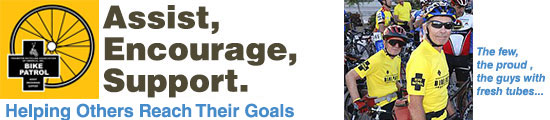
The mission of Perimeter Bicycling’s Bike Patrol Program is to provide assistance, encouragement, and support for the participants of Perimeter events. Patrollers offer mechanical assistance, first aid as needed and encouragement to successfully finish the ride.

Perimeter Bike Patrol is a group of nearly 300 certified cyclists who bring enthusiasm for cycling and a deep pool of experience to ensure the success of thousands of riders in Perimeter events every year.

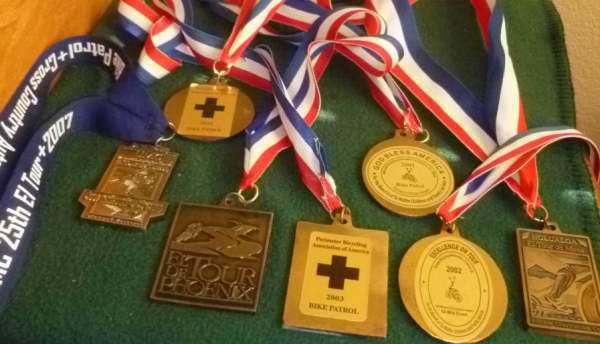
There is also an award for outstanding Bike Patrol in each event.
And of course, all Bike Patrol receive a finisher’s medallion.

Who can participate?

The typical bike patroller is a fit, experienced, and enthusiastic cyclist with basic mechanical skills (fix a flat, correct a thrown chain); knows and practices the rules and procedures of safe cycling, and is willing to assist and encourage other cyclists. A basic understanding of first aid is helpful but not required.
Different ride distances are available to accommodate all ages and sizes of riders. You ride at your own pace (preferably with a partner), but plan on many stops to help riders.

How much does it pay?

For a modest processing fee you get to ride a great event, a striking yellow tee-shirt, a cool medallion, excellent sag stops, and a priceless amount of appreciation and satisfaction. While maybe not rock-star status, you will receive many positive strokes from those you help or who have been helped by others in the past.

What do I have to do to qualify?

Register, attend a certification course, show up early to help at the start, and agree to do all you
can to ensure participants will have a safe and fun event. If you are uncertain about your qualifications, you may request to be paired with an experienced Bike Patroller or team. Review the Bike Patrol Manual (available on-line) before you attend the certification class. Classes are normally held several times each fall; and are held in both Phoenix and Tucson.

How long do I have to be at the event?

Be there early to help at the start, complete the ride, check in at the finish, pick up your
medallion, and then you are finished.

Why is patrol necessary?

A surprising number of riders will need your assistance. They appreciate getting back on the road promptly without a long wait for sag assistance. Bike Patrollers are the eyes and ears of the tour, ready to report or correct problems and assist with mechanical, medical, and motivational emergencies in real time.

Do I have to provide tubes and tire-changing tools?

You will be advised about what tools are useful at the certification class. You may receive a tube or two at packet pickup. Most riders will have their own tubes. A few will not. I always carry a few patched road bike tubes for those who need them and a glue-less (Park is the best) patch kit for odd-sized wheels.

What are other duties of bike patrol?

Assistance, encouragement, and support are paramount. Call in or text every time you stop to provide assistance, or at least at every sag stop. If you observe riders behaving badly or breaking event rules, ask them to mend their ways. If they do not cooperate, report their rider numbers and the circumstances via text, call, or at the next sag stop. There will be consequences.

What do I do if I encounter a crash?

Secure safety for any victims and, if serious, call 911. Provide any first aid that you comfortably can. Stay until help arrives or you are certain a rider can continue. Report the incident via text or call. Complete a report form for all but simple events handled on-site. There can be an events that will be challenging. Some examples I have encountered are hypothermia, hyponatremia, diabetic incidents, heat distress, and severe cramps. These are mid-level events that can be treated on-site if caught early, but can also require professional medical attention. You will make the call – treat, call for support/pickup, or call 911.

What should I do to be prepared?

Be sure your own bike is in good shape before the ride. Bring a fully-charged cell phone.
Between the Bike Patrol Manual and the certification class, you will be prepared. Ride with a partner for fun, efficiency in carrying out duties, and assistance when needed.
If you are interested in being a part of bike patrol, visit perimeterbicycling.com/bike-patrol to learn more and sign up.
P1020292_01

Look Ma, no hands!

There is a special law applying specifically to bicyclists; it often gets repeated as

You must have at least one hand on the handlebars at all times

Which is what appears both on the Arizona Governor’s Office of Highway Safety (AZ GOHS), and the City of Phoenix websites, it is a misrepresentation.

While this is the law in some places, e.g. Utah (41-6a-S1112); the law in Arizona actually reads:

ARS 28-816. Carrying article on bicycle

A person shall not carry a package, bundle or article while operating a bicycle if the package, bundle or article prevents the driver from keeping at least one hand on the handlebars.

So, while you should and must ride under control for safety’s sake, it’s not intrinsically illegal to ride with no hands.


World Day of Remembrance for Road Crash Victims

November 15, 2015 is World Day of Remembrance for Road Crash Victims. Right here in Arizona in just the last year , 884 persons were killed in Arizona traffic crashes. This includes 589 motorists, 157 pedestrians, and 28 bicyclists. Many thousands more were injured.

This year the theme is “Crash Not Accident” – an initiative focused on changing the way we think and talk about crashes. Most crashes are not “accidents”, rather they should  be viewed as preventable incidents. Yet, the “A” word which connotes some level of innocence, is the ubiquitous term used in describing these incidents by media, some highway safety officials & others. Negligent, and even criminal, drivers hide behind the word, as if “lack of intent” absolves them of their actions and the hurt that they’ve caused. #CrashNotAccident