A person shall not carry a package, bundle or article while operating a bicycle if the package, bundle or article prevents the driver from keeping at least one hand on the handlebars.
So, while you should and must ride under control for safety’s sake, it’s not intrinsically illegal to ride with no hands.
this is the next in an occasional series on laws governing bicycle use in Arizona
In the last installment, we noted that a bicyclist is subject to the rights and responsibilities of a “driver of a vehicle”, as well as some special rules which apply specifically to bicyclists; and that there were important legal distinctions between the driver of a motor vehicle and a bicyclist. Today we examine a special responsibility applicable only to the driver of a motor vehicle — the duty to overtake a bicyclist proceeding in the same direction not only safely, but with a minimum of three feet of clearance.
The general rule for a driver overtaking another vehicle is as follows:
§28-723. Overtaking a vehicle on the left
The following rules govern the overtaking and passing of vehicles proceeding in the same direction:
1. The driver of a vehicle overtaking another vehicle proceeding in the same direction shall pass to the left of the vehicle at a safe distance and shall not again drive to the right side of the roadway until safely clear of the overtaken vehicle…
A special rule was created by bicyclist advocates in 2000, HB2625, to bring attention to overtaking, allow for increased fines for violators, and to provide for additional educational opportunities. The rule applies only to the driver of a motor vehicle when overtaking a bicyclist, the new statute reads, in full:
§28-735. 28-735. Overtaking bicycles; civil penalties
A. When overtaking and passing a bicycle proceeding in the same direction, a person driving a motor vehicle shall exercise due care by leaving a safe distance between the motor vehicle and the bicycle of not less than three feet until the motor vehicle is safely past the overtaken bicycle.
B. If a person violates this section and the violation results in a collision causing:
1. Serious physical injury as defined in section 13-105 to another person, the violator is subject to a civil penalty of up to five hundred dollars.
2. Death to another person, the violator is subject to a civil penalty of up to one thousand dollars.
C. Subsection B of this section does not apply to a bicyclist who is injured in a vehicular traffic lane when a designated bicycle lane or path is present and passable.
Note that the minimum safe distance of not less than three feet, subsection A, applies on all streets in Arizona. Streets come in a wide variety of configurations, most streets are divided into lanes, but others are not, some have shoulders, or no shoulders, paved or unpaved, some have designated bicycle lanes, many do not. The minimum safe distance of not less than three feet applies on all streets in all configurations regardless of the position of the bicycle to be overtaken.
R4-11 BMUFL sign with Change Lanes to Pass placard
On many streets with lanes, the lane is not wide enough to safely share side-by-side with a vehicle and the bicycle. Drivers of vehicles in this situation will need to change lanes, at least partially, in order to pass safely and legally. Since the adjacent lane must be clear to move even partially into it, the Coalition encourages drivers to make a full lane change when passing, the same as when passing any other vehicle.
There is a misunderstanding that the minimum safe distance of not less than three feet does not apply on streets with designated bike lanes; this is simply not true. Subsection C states that the enhanced fines of subsection B do not apply if a bicyclist is struck while riding outside of a “passable” designated bicycle lane. It has no relevance to Subsection A. Subsection A always applies.
Note that Subsection C is presumably poorly drafted in that it does not allow for a bicyclist who is legally turning left to be “protected” by subsection B — although an overtaking motorist is still, as always, required observe the minimum safe clearances specified in subsection A.
Education
In addition to the minimum three foot passing law, HB2625 also added a new directive to include “those practices and laws relating to bicycles” (underlined below) and as a result ADOT/MVD has added a question relating to bicycles to the Arizona’s drivers license test
§28-3164.B. The (drivers license) examination shall include all of the following:
1. A test of the applicant’s:
(c) Knowledge of safe driving practices and the traffic laws of this state, including those practices and laws relating to bicycles.
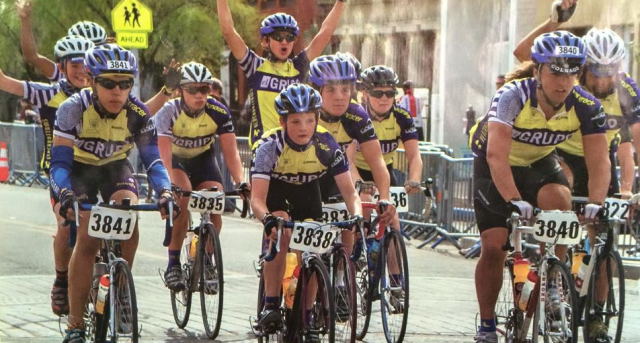
Seventeen members of El Grupo, a Tucson-based youth cycling organization, qualified for the 2015 USA Cycling Elite Amateur National Championships. It is the first time El Grupo athletes have qualified to compete in the National Championships.
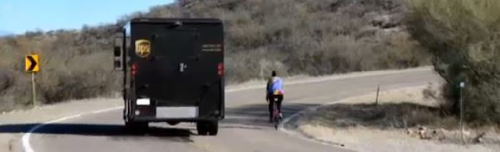
The Tucson-Pima County Bicycle Advisory Committee recently sent a letter to the Pima County Department of Transportation Director, Priscilla S. Cornelio, outlining areas of concern regarding a “dangerous” road in Green Valley; Camino de la Canoa near White House Road. The letter recommended lower speed limits, additional signs, and a bicycle lane.
The Coconino County Board of Supervisors recently approved a resolution to designate five stretches of county-owned road as part of an official cross-country network of bicycling routes.
The United States Bicycle Route System is a developing network of interstate long-distance cycling routes in the United States. The system utilizes multiple types of bicycling infrastructure, including off-road paths, bicycle lanes, and low-traffic roads. The USBRS is the bicycle equivalent to the system of United States Numbered Highways. Envisioned to traverse the entire country, the USBRS is analogous to other national cycling route networks such as the Dutch LF-routes, the United Kingdom’s National Cycle Network, and is as comprehensive as the international EuroVelo network that spans Europe.
Actually, we should have said: riders of bicycles are not bound by rules that apply only to drivers of motor vehicles…
It’s helpful to note that the “rules of the road” apply not to vehicles, or bikes, but rather to the people operating these things. A typical example is the rule for what to do at a stop sign, §28-855(B). “A driver of a vehicle approaching a stop sign shall stop…”.
In Arizona, bicycles are, by definition, not vehicles; nor are they motor vehicles. Here are those definitions §28-101:
§28-101. Definitions
...
58. "Vehicle" means a device in, on or by which a person or property is or may
be transported or drawn on a public highway, excluding devices moved by human power
or used exclusively on stationary rails or tracks.
33. "Motor vehicle":
(a) Means either:
   (i) A self-propelled vehicle.
   (ii) For the purposes of the laws relating to the imposition of a tax on motor
   vehicle fuel, a vehicle that is operated on the highways of this state and
   that is propelled by the use of motor vehicle fuel.
(b) Does not include a motorized wheelchair, an electric personal assistive mobility
device or a motorized skateboard...
So, if a bicycle is not a vehicle, why does a cyclist have to stop at stop signs? Simple, because of a law helpfully titled Applicability of traffic laws to bicycle riders, §28-812,
§28-812. Applicability of traffic laws to bicycle riders
A person riding a bicycle on a roadway or on a shoulder adjoining a roadway is
granted all of the rights and is subject to all of the duties applicable to the
driver of a vehicle by this chapter and chapters 4 and 5 of this title, except
special rules in this article and except provisions of this chapter and chapter
4 and 5 of this title that by their nature can have no application.
This is a cyclist’s fundamental right to the road; the equal of driver’s.
Note well that it refers specifically to the rights and duties of the driver of vehicle — and NOT the driver of MOTOR vehicle, in fact the word motor does not appear at all in 28-812.
It might surprise you to note that the phrase “motor vehicle” occurs only a handful of places in ARS Title 28, Transportation, with respect to how a driver must operate a vehicle. By far, most driver’s duties refer, as in the stop sign example above, simply to vehicle.
Some references are incidental; lane and speed restrictions on motor vehicles weighing over 26,000 pounds (§28-736, §28-709). Another was intended to set minimum passing clearance when a motor vehicle overtakes a bicycle (§28-735). Two germane examples for cyclists are following distance, and impeding traffic.
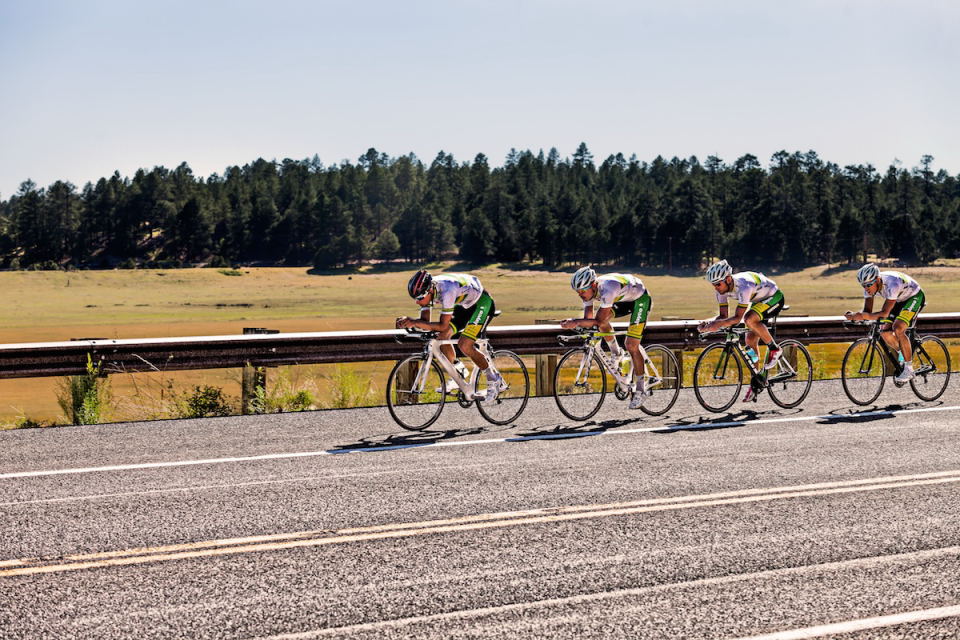
§28-730, “The driver of a motor vehicle shall not follow another vehicle more closely than is reasonable and prudent…”, without the word motor in this statute, pacelining would likely be illegal. Since reasonable people would probably agree that a couple of inches is an inappropriately small following distance.
§28-704(A), “A person shall not drive a motor vehicle at such a slow speed as to impede or block the normal and reasonable movement of traffic…”. This is what I refer to as the cyclist’s second most fundamental right to the road, because if this statute were to apply to cyclists, then they would in effect be not allowed to use any road where traffic even might be impeded; regardless of number of lanes, width, presence or absence of a bike lane, or anything else. There is some detailed minutia [see footnote 2, here] revolving around what is meant by the “normal and reasonable movement” but that is immaterial to cyclists, since this section is inapplicable to them.
Likewise, §28-701(E) “A person shall not drive a MOTOR vehicle at a speed that is less than the speed that is reasonable and prudent under existing conditions”, never applies to bicyclists.
The point is that the phrase motor vehicle is used sparingly and deliberately to apply only to drivers of that type of vehicle, reflecting clear legislative intent. In the case of 28-704(A) to allow cyclists to use all roads even though motorists might sometimes be impeded (with some caveats: There is a specific allowance for prohibiting bicycles on controlled access highways, and other roads on a case-by-case basis). And the purpose of these laws is so that bicyclists can ride both legally and safely in the road according to best practices.
this is one of an occasional series on laws governing bicycle use in Arizona
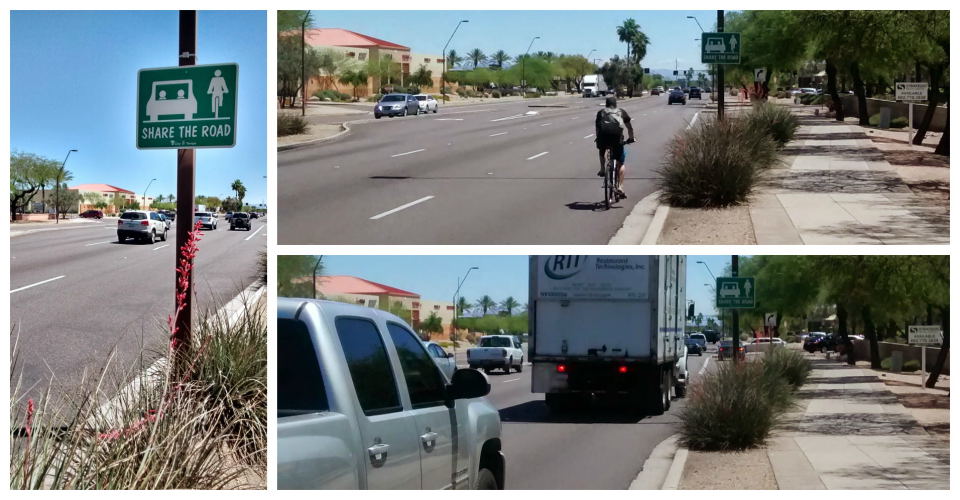
Elliot Road, eastbound east of Priest Drive, City of Tempe. Sign placed by the city reminds users to “Share the Road”. Posted speed limit 45mph. Even the fastest bicyclists will be traveling well below the posted speed limit. This arterial, like most, has lanes which are “too narrow to share safely side by side”, and as such, cyclists going straight ahead are advised to ride near the center of the right-most through lane. Motorists wishing to overtake must change lanes (at least partially) to pass legally and safely.
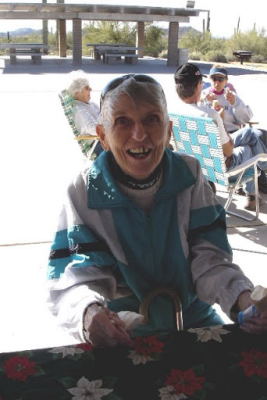
Gurnelle Jones, initiator of the Annual New Years Day PPP Usery Park potluck.
by Roseann Wagner
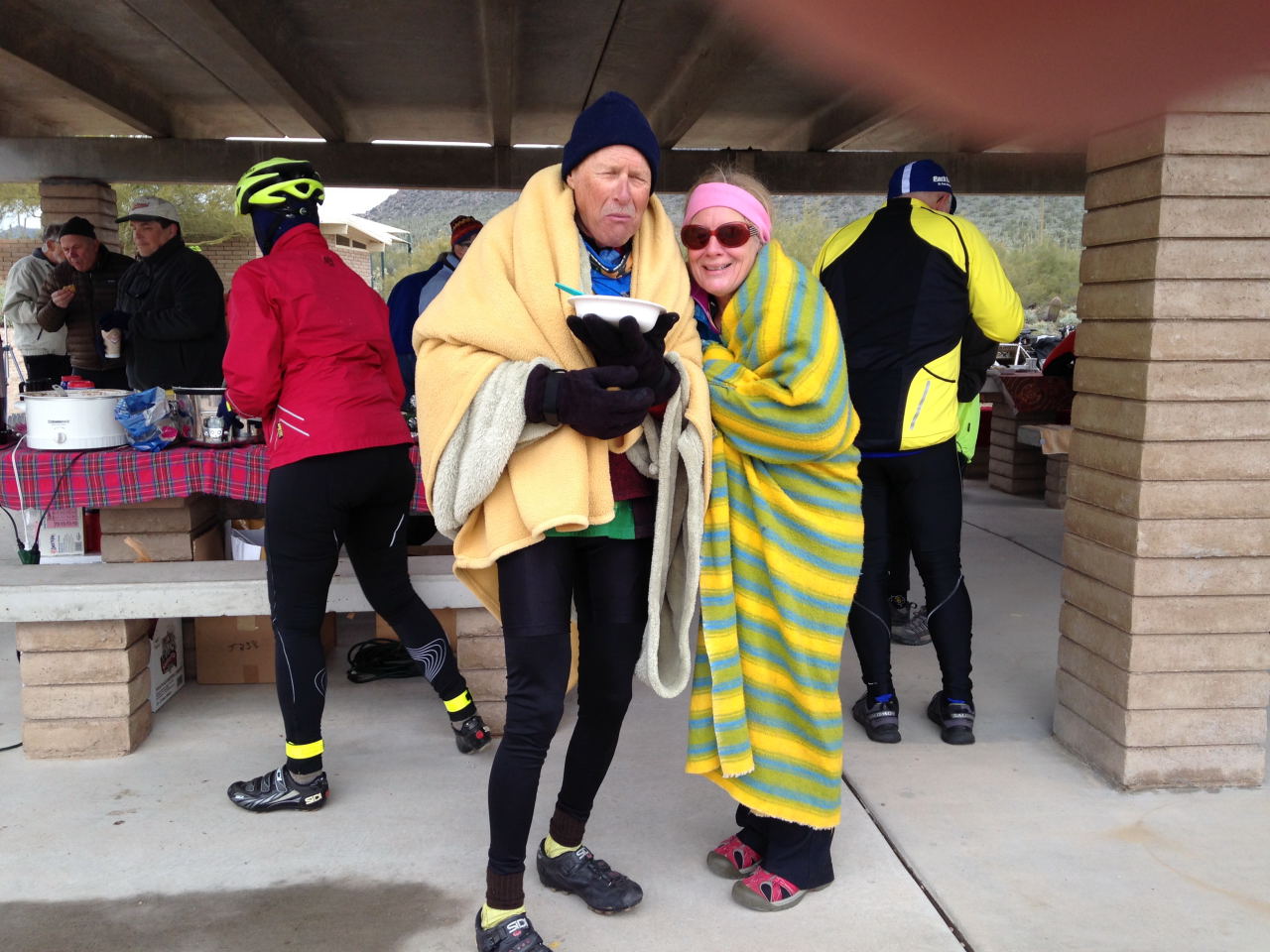
When I arrived at the Usery Mountain Regional Park for the 2015 version of the New Years Day Pinnacle Peak Peddlers potluck at 9:00 A.M. the thermometer registered 34º. When I left at 1:15 P.M., the thermometer showed 42º. What transpired in that 8º window?
First order of business, get that 40-cup coffee pot perking. Set out all the utensils and plates. Cups for not only coffee, and cocoa, but champagne with which to toast the New Year are set out. Thereʼs a table for hot dishes, a table for desserts, and several tables for socializing.
People start to arrive with food, chairs, and blankets. Since I was nursing a cough and sneezes, I brought my heater and a heating pad. Considering Arizona weather, I layered because certainly I assumed Iʼd get too warm with a cotton turtle neck, a wool vest, a wool sweater and a rain jacket. NOT! I appreciated my wool socks and all the other trappings that I hauled out there.
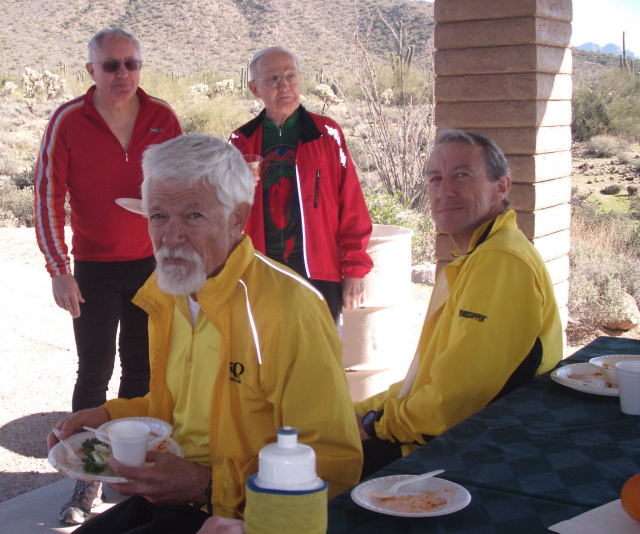
Regulars who ride from Ahwatukee / Tempe to the picnic site at Usery Mountain Regional Park, from left to right, Walt Paciorek who has led a ride before the potluck each year for six years, Roy Kopel, Bob Prochaska, long-time ride leader of the Sun Lakes Bicycle
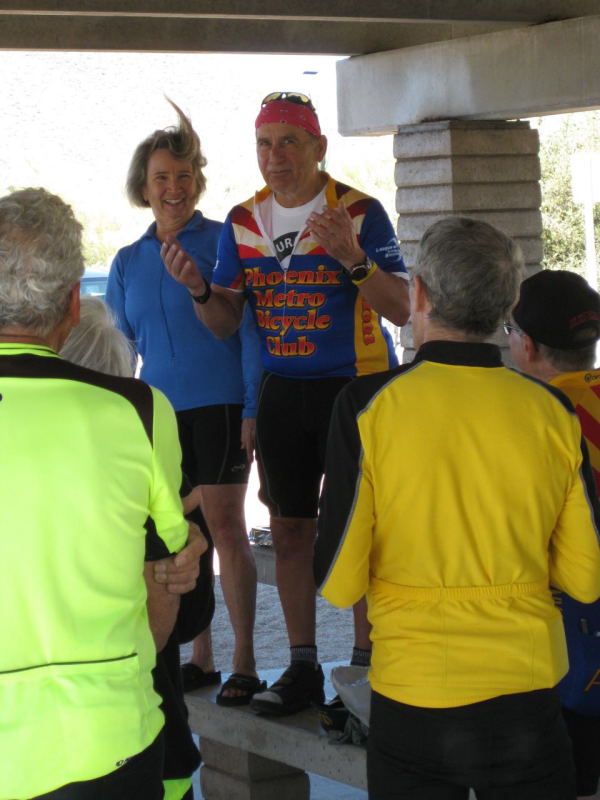
Cyclists gathered at Ramada D-1 around 10 :30 for a 20 mile ride around the area led by Walt Paciorek. Walt shared the following, a cue sheet for the ride and a bit of local lore:
PPP ’15 Ride – 20 miles (one major climb), 23 miles (climbs), 30 miles (lots of
climbs)
Mile 0 Exit the picnic area and proceed to the park Entrance
1.2 Turn right on Usery Pass Road
4.6 Right on Bush Highway
9.8 Entrance to Water Users Camp Circle (return for 20 mile ride)
11.4 Saguaro Lake Road (proceed to Marina and return for 23 mile ride)
12.3 Butcher Jones turnoff
15.2 Butcher Jones Beach (and back for 30 mile ride)
At the close of the 19th Century, Dr. Walter William Jones, a physician-rancher, ran cattle from the Lower Salt River to the foothills of Four Peaks. “Butcher” was a common nickname for physicians during this period. After the Stewart Mountain Dam was completed and Saguaro Lake filled in 1930, a cove and beach were named “Butcher Jones” by those who remembered the good doctor. “Usery” comes from King Usery, who had a ranch around there at the same time. Jack Stewart also ranched the area, apparently just after Jones and Usery.
Weddings are announced
As Waltʼs group returned and cyclists biked in from Sun Lakes and Tempe, the socializing began in earnest. No one had to be called twice for food–hearty chili and other nourishing hot food.
A new feature of the gathering this year was a collection of bike clothes and bike parts that have been sent to Lon Haldeman of PAC Tour who for the last decade has nurtured biking in S. America and Africa as well as furnishing books to orphanages and building schools in Lima, Peru.
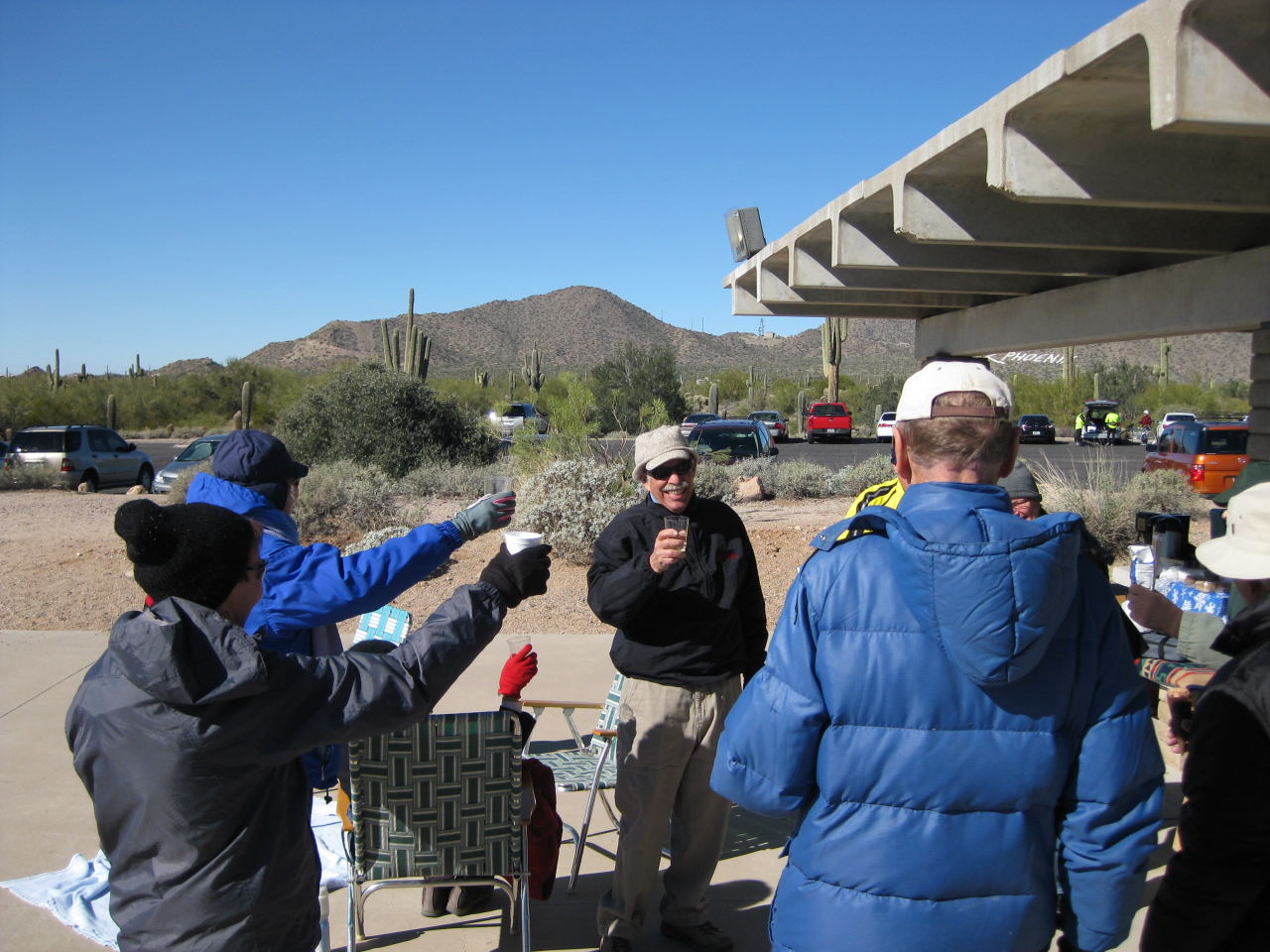
A toast to our beloved leader, Gurnelle Jones who passed away at age 90 in 2010
This is how Lon describes the events: “For the past five years the racing club in Lima, Peru has been organizing a two-day-stage race in the northern part of the city. The reason it is called the Gringo Race is because all the prizes have been donated by PAC Tour riders and other American cyclists. This race has the best prizes of any event in Peru. We will take over 250 jerseys, shorts and various cycling supplies to Peru. The first stage is an 80 KM road race through the desert sand dunes. The next day is a 20 KM criterium through the small streets of the town of Puente Piedra. There will be about 200 riders in various age groups attending the races”.
This year on New Years Day, we collected many items including a dozen bike shorts, forty-three jerseys of all kinds, four helmets Trek, Giro, etc., shoes, 6 pair, socks, some never worn, 9 jackets, some light, some heavy, seven tubes, a box of water bottles plus, several Camelbacks, bike bags and fanny packs and bike parts to use for repair It cost $195 to ship three boxes all from donations.
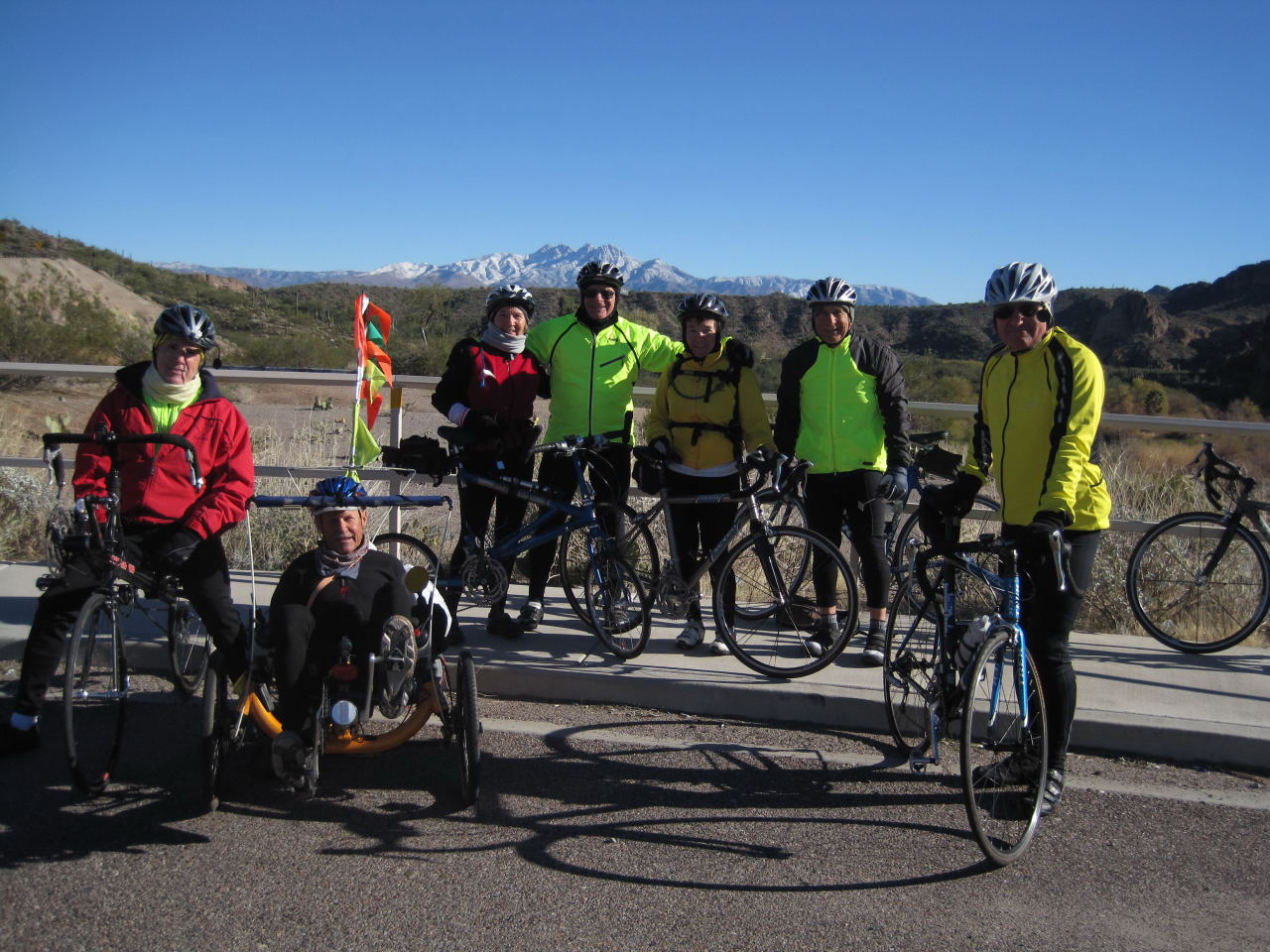
Snow in them thar hills did not deter seven brave riders. New Years, 2011
Within days, the reservation for the next annual PPP potluck are made by Walt.
The Olympics and Tour de France are world-class events of which we’ve all heard. Although we are close neighbors to a Commonwealth nation, Canada, what do you know about the Commonwealth Games? And what is Arizona’s connection to those Games? Read on. Continue reading Commonwealth Games
Chandler, AZ couple Steve and Kathy McDermott describe their 4,500 mile transamerica adventure.
by Steve and Kathy McDermott
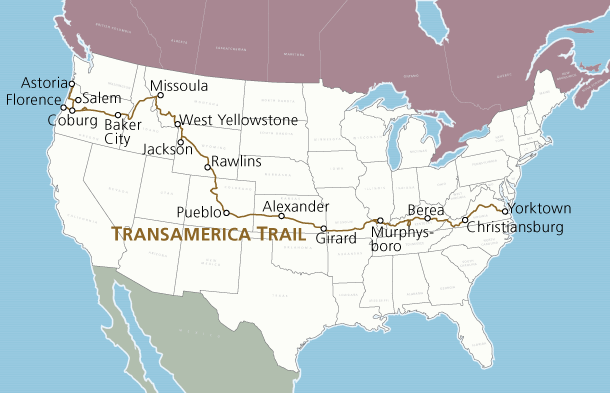
We decided that this summer (2014) was going to be THE summer that we cycled cross the United States. Using Adventure Cycling’s Trans Am Route, we left Mechanicsville VA May 13 for our wonderful adventure. Our route, with some deviation, took us 114 days (88 cycling and 26 planned off days), totaled 4,546 miles, with 173,941 total feet of climbing. We love cycling and bicycle touring but had never done a self supported tour lasting more than 3 weeks. We have been married 36 years and travel extremely well together. This entire trip was not a one-person-did-it-all adventure. We have no children and are very close in everything we do. We did not once feel the need to get away from each other. You must be on the same page as your travel partner or you are setting yourself up for disaster. Our years of marriage pretty much took care of this for us. We cannot for one minute imagine having done this trip with anyone but each other. We both feel so very fortunate to enjoy the same activities. This trip would not have been the same with anyone else.
We like plans so we, in essence, planned a one to two week vacation every couple weeks in order to have a definite place to stay and known route. We did prepare cue sheets prior to the trip which were immensely helpful. We just read the turns on the Adventure Cycling Maps and typed up the cues. We stayed in hotels/motels every night except for a few nights when we stayed in a bicycle hostel. Our preference is not to camp; however, we did carry a light tent, sleeping sacks and Thermarest pads in the event we were forced to camp.
We were very thankful for GPS and smart phones, although cell coverage was sporadic in some parts of the country. We carried an iPad with a wireless keyboard to create an on line journal and posted daily updates. If you are interested in our journal, the link is as follows: www.crazyguyonabike.com/doc/kstransam2014
We flew from our home in Chandler AZ to Richmond VA. We traveled east to west because we knew the heat, humidity and hills in Virginia, Kentucky, southern Illinois and Missouri were going to be brutal. We were not disappointed. We have biked the Rockies in the past, and we were looking forward to biking towards them. Many people also feel the prevailing wind is west to east. From the countless journals we read both before and during the trip, this is not true. We had just as many days with tailwinds as headwinds. Which direction you travel is a personal preference; ours was east to west.
climb from Halfway,OR to Richland,OR
Physically the trip was very demanding. We are 63 years old, avid and very experienced cyclists, and had some very tough days. However, it was nothing more than we had done before. We were each carrying about 50 pounds of gear on our touring bikes. You must remember bicycle “touring” is different from daily riding. Although we approached each day with the attitude that it is just another day ride, we were in no hurry. We averaged approximately 10 to 12 MPH most days. Our slowest day was approximately 7 MPH and our fastest approximately 14 MPH.
We had many good days and a few not so good. Numerous factors enter into the evaluation of a day; e.g., weather (rain/sun/snow; wind; temperature; humidity); traffic; road conditions; road surface, scenery; and terrain. It is all relative as a bad day could be an exceptional day given different conditions.
The people we met did make the trip, and we met countless people who made the trip enjoyable. The simplicity of self supported bicycle touring for an extended period of time is liberating. Everything we needed was on that bicycle, and we had more than enough. We did not carry food or cooking gear, opting instead to eat in restaurants. However, we did always have emergency rations and snacks on the bikes.
Grand Tetons
We biked through Virginia, Kentucky, Illinois, Missouri, Kansas, Colorado, Wyoming, Montana, Idaho and Oregon. Everyone in every state was wonderful to us. However, our favorite state was Kansas for the people. Our favorite states for scenery were Colorado, Wyoming and Oregon. Not that we needed confirmation, but this trip most definitely confirmed that America is beautiful, and we are so very proud to be Americans. It was wonderful to see it all at an average speed of approximately 10 MPH.