
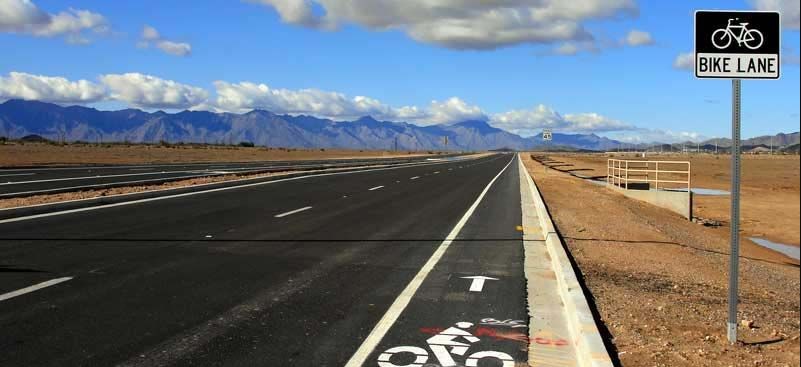
The U.S. Department of Transportation Federal Highway Administration (FHWA) and the National Association of City Transportation Officials (NACTO) both provide guidelines for communities to use when determining the appropriate type of bike lane on streets and roadways. Both agencies recommend that separated or protected bike lanes be used for roads at much lower speeds than are seen in most Arizona communities. Continue reading Is Your Community Following National Guidelines When Installing Bicycle Lanes?

Arizona Bicycling Summit 2022
Registration open; agenda posted; visit cazbike.org/summit2022/
Meet Earl Ratledge
 A lifelong bicycle rider, Earl Ratledge can be found riding around the east valley for recreation and to run errands. He rides a road bike, mountain bike, folding single speed, and an upright bike with baskets in the back. For 13 years Earl commuted between Mesa and Phoenix using a mix of bike-bus-bike, bike-bus-walk and bike-bus-light rail; and for 3 years took his kids to school in a bike trailer. Over the years he has taken part in bicycle races, multi-day rides, bike camping, and charity rides.
Earl is the editor of the Coalition’s newsletter and has published articles on the Coalition’s website. He has volunteered with CycloMesa, Recycle Your Bicycle and Tour de Fat. Earl also developed a public dashboard which maps crashes in Arizona that involve people on bicycles and identifies the most dangerous intersections and corridors.
Earl can be reached at newsletter@cazbike.org
People Who Ride Bicycles on the Roadway Already Pay Their Share
People Who Ride Bicycles on the Roadway Already Pay Their Share

When there is conversation about building bicycle facilities, we often hear rumblings that people who ride bicycles don’t pay their fair share of the expense of transportation infrastructure. This statement is not true. Bicycle riders often pay more than their share for the amount of bicycle infrastructure created, and for the amount of roadway they actually use. Bicycle riders also provide more financial contributions to the local economy then drivers of cars. Continue reading People Who Ride Bicycles on the Roadway Already Pay Their Share
Coalition of Arizona Bicyclist’s Annual member’s meeting 10/19/2021
This year, the annual business meeting will be held via tele-conference.
A business meeting and election of open board of directors seats will be held.
- Tuesday, October 19 , 2021 at 6:30PM Arizona Time.
Members in good standing who wish to attend/listen/vote please contact cazbike@cazbike.org no later than 10/13 to obtain the phone in details. Not a member? Click here to join.
Nominations, or self-nominations for the Board of Directors are still open, and as always we’re looking for volunteers in any capacity. Continue reading Coalition of Arizona Bicyclist’s Annual member’s meeting 10/19/2021

We earned 2021 GuideStar Silver Seal of Transparency
We earned a 2021 Silver Seal of Transparency! Learn more about our organization on GuideStar, an independent aggregator of information about 501c3 – registered organizations. You can view our IRS determination letter along with other corporate documents here.


ADOT Bicycling and Pedestrian Notifications
If you are interested in receiving notifications about ADOT projects that impact bicycling and walking in your area in Arizona, you can subscribe at activetransportation.az.gov look for the big green “subscribe for notifications” button.
 After subscribing, you can adjust which regions you will be notified by clicking on “subscriber preferences”
Note that the notifications only apply to roads maintained by ADOT, the state highway system.
While you are visiting azbikeped.org be sure and check out Arizona Bicycling Street Smarts. [online version available from archive.org]
You Can Help Improve Your Communities Bicycle Network
 A number of Arizona communities recently passed initiatives to expand transportation infrastructure including improving bicycle facilities. In addition, there is proposed federal legislation that would make additional moneys available for expanding active transportation networks. This poses the question, what can you as an individual do to improving bicycle facilities in your community?
The first recommendation is to review the city’s transportation plan and active transportation plan if there is one. Do these have specific goals in creating bicycle infrastructure? If so, that should be a guide in the development process. Also determine if your community has a bicycle coordinator or a specific person to contact for bicycle related projects and programs. This is someone you can reach out to directly with your questions and concerns. Some cities, such as Flagstaff and Tucson, have citizen bicycle committees. Many cities have a specific web page with this information.
Once your communities’ plans have been reviewed and understood, there are a number of approaches for improvement. While it would be best for communities to work on all the approaches listed below, resource limitations make this unrealistic.
One approach is to improve the existing bicycle network. This includes
- Updating all bike lanes in the network to follow the guidelines for lane width and separation
- Make sure that bike lanes don’t have gaps or just end, leaving riders in dangerous situations
- Make sure intersections where the network crosses major streets are set up for safe crossing
- Install a method for people on bicycles to activate traffic signal at signaled intersections
- Make sure there is sufficient signage to identify the bicycle network for riders and drivers
- Work with other communities so bicycle networks connect across jurisdictions
Another approach would be to develop a new bicycle network or expand the existing network. This could focus on creating or improving routes
- From high population areas to high employment areas
- In areas with low car ownership and/or high numbers of bicycle commuters
- For better connection with public transit
A third approach would be to focus on high crash intersections and corridors.
- Identify the most dangerous areas for people on bicycles
- Develop infrastructure changes that improve safety for all road users
Some of these approaches could overlap. For example, if the goal was to bring all bicycle lanes in compliance with guidelines from National Association of City Transportation Officials (NACTO), the bike lanes on the most dangerous corridors could be the priority.
A recent analysis by the Virginia Department of Transportation found that zero vehicle households and employment density were two of the strongest predictors of the locations of crashes between motor vehicles and non-motor vehicles. The number of zero vehicle households and employment density for all U.S. cities is available from the U.S. Census Bureau as part of the American Community Survey. In Maricopa County, the Maricopa Association of Governments (MAG) manages an interactive mapping website with census information; including population, employment, rate of car ownership, and transportation mode by zip code and census block. https://ims.azmag.gov/ This information is also available for all areas of Arizona through the U.S. Census Bureau using the Census Reporter and other Census tools. https://censusreporter.org/
Other pertinent traffic information is often available online. The City of Mesa updates their traffic counts annually at https://www.mesaaz.gov/residents/streets-transportation/traffic-counts, and provides a map showing posted speed limits at https://www.mesaaz.gov/home/showpublisheddocument?id=35998. Your community likely has this type of information available to help determine if the appropriate bicycle facilities are in place on your streets.
An interactive dashboard which includes a map of Arizona bicycle crash locations from 2015 to 2019 is located at https://public.tableau.com/app/profile/et.ratledge/viz/ArizonaTrafficCrashesInvolvingBicycles/AZBicycleCrashes.
If you are interested in how bicycle facilities should be designed, the Federal Highway Administration (FHWA), NACTO, and others offer a number of free resources for bikeway design and selection. These include the
- Urban Bikeway Design Guide https://nacto.org/publication/urban-bikeway-design-guide/
- Bikeway Selection Guide https://www.pedbikeinfo.org/pdf/Webinar_PBIC_032619.pdf
- On-street Motor Vehicle Parking and the Bikeway Selection Process https://safety.fhwa.dot.gov/ped_bike/tools_solve/docs/FHWA-SA-21-009_On_Street_Motor_Vehicle_Parking.pdf
- Traffic Analysis and Intersection Considerations to Inform Bikeway Selection https://safety.fhwa.dot.gov/ped_bike/tools_solve/docs/FHWA-SA-21-010_Traffic_Analysis_Intersection_Considerations.pdf
- Pedestrian and Bicyclist Road Safety Audit (RSA) Guide and Prompt List https://safety.fhwa.dot.gov/ped_bike/tools_solve/docs/fhwasa20042.pdf
- You can find a complete list of FHWA bicycle related publications at https://safety.fhwa.dot.gov/ped_bike/tools_solve/
The FHWA offers free Bicycle Facility Design training through its National Highway Institute. This training is open to anyone. https://www.nhi.fhwa.dot.gov/course-search?tab=0&typ=3&sf=0&course_no=142080
Regardless of your place in the bicycle community, rider, advocate, planner, engineer or elected official, you can participate in working to improve and expand the bicycle network. You can start reviewing the information available in your area and working with others to make your roads safer and more efficient for people on bicycle.
Your Opportunity to Comment On the Manual on Uniform Traffic Control Devices

The Manual on Uniform Traffic Control Devices (MUTCD) is up for review and comments are being accepted through May 14, 2021. As stated in the Federal Register, the MUTCD is “recognized as the national standard for traffic control devices used on all public roads.” The standards in this manual include traffic controls, signs, and roadway markings. The MUTCD has historically focused on moving motor vehicle traffic quickly, with little regard for the safety of non-motorized road users.
This is an opportunity for you to recommend changes to the MUTCD that are more inclusive for people that ride bicycles on our roadways. We created a template that you can use as a guide in providing your own comment to the Federal Highway Administration (FWHA). Please copy this letter, make any changes you feel are appropriate, and post to the Federal Register Comment Site listed below.
To: Stephanie Pollack
Acting Administrator
Federal Highway Administration
As a member/supporter of the Coalition of Arizona Bicyclists, I request that the Manual on Uniform Traffic Control Devices (MUTCD) be revised to better support non-motorized road users. Changes should be made to lower speeds, improve bicycle facilities, and treat all road users equally. These changes can create a shift that will reduce traffic deaths and injuries, and make it easier for people that are not in cars to move around their communities.
The MUCTD currently prioritizes the fast movement of motorized traffic without regard to the safety of other road users. This should change. Specific changes that should be made include:
-
-
- Stop using the 85th percentile when setting speed limits. There are more current methodologies that better account for the needs of non-motorized road users.
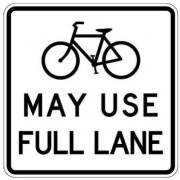
- Review bicycle related signage and road marking. Consider making optional signs and road marking required, and allow bicycle rider specific signs.
- Stop using the number of people killed or injured as the measurement that ‘warrants’ changes to make a roadway or intersection safer.
- Incorporate the criteria from the FHWA’s Bikeway Section Guide into the MUTCD so that selection of the appropriate bicycle facility for a roadway is based on traffic speed and volume.
-
Bicycle ridership has been on the increase in the United States, so please consider people on bicycles and other non-motorized road users in the review and changes to the Manual Uniform Traffic Control Devices.
Sincerely, [your name here]
Please note that all comments become public information. So be aware of what you write, and decide for yourself what personally identifying information you include.
Federal Register Comment Site: https://www.federalregister.gov/documents/2021/02/02/2021-01440/national-standards-for-traffic-control-devices-the-manual-on-uniform-traffic-control-devices-for#open-comment
Further Resources:
MUTCD Official Site https://mutcd.info/
MUTCD Bicycle Page: https://mutcd.fhwa.dot.gov/pdfs/2009/part9.pdf
Toole Design posted a table that contains specific wording changes and location of those changes in the revised MUTCD. This document can be searched for specific bicycle references. https://www.regulations.gov/comment/FHWA-2020-0001-0853
Learn more about the MUTCD at this recorded webinar: The ’Notorious’ MUTCD – Why Fixing a Federal Manual is Critical to Safety, Equity and Climate https://americawalks.org/the-notorious-mutcd-webinar-recording/
The need for better law enforcement training

Destination positioning is a central and foundational concept of bicycle traffic safety. Moving away from the far right is at times not just legal and not just safer for a bicyclist, but is at the same time courteous to drivers behind. While most law enforcement officers know the rules and do the right thing, there are times where better training is necessary. Read here about one bicyclist in Phoenix recently who was unfairly ticketed for not being “far to the right” while waiting at a red light, and the great lengths he had to go to get justice.
If you believe you have been unfairly ticketed by a police officer, although the Coalition cannot represent you, we would like to know about it. We would also encourage all bicyclists to view the law enforcement training that was put together jointly by the Coalition and Glendale Police Department; and encourage your own local police force to provide specific training to their officers on bicycle traffic safety and law enforcement.