
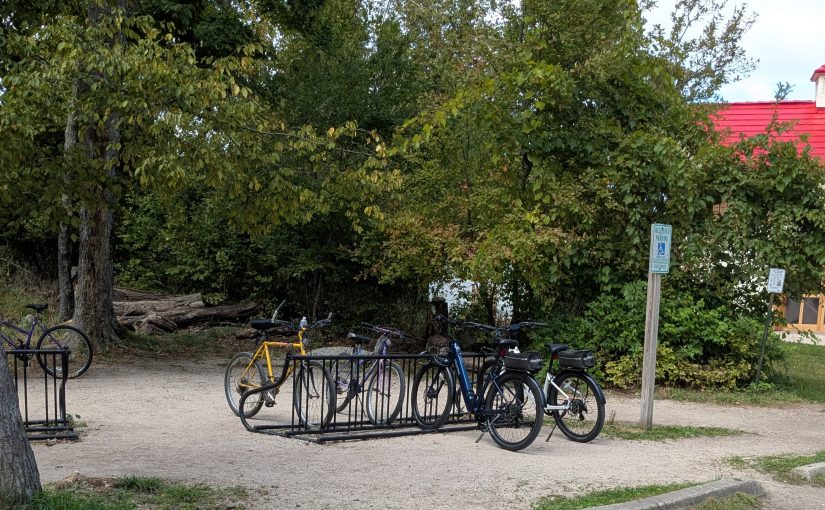
Having green space in urban areas has been shown to improve people’s physical and mental health, improve quality of life, and have a positive economic impact on communities. As your community develops land, you should encourage opportunities to include and expand public green spaces, both big and small. The key is having green spaces that are close to where people live.
(See the table at the bottom of this article to see how many people can walk to green space in your Arizona community.)
What Is Green Space
‘Greenspace (sometimes ‘green space’) is an umbrella term used to describe either maintained or unmaintained environmental areas, which can include nature reserves, wilderness environments and urban parks.’ [1] ‘Green spaces can be defined in many ways, from narrow (e.g., forested areas) to broad (e.g., any landscape that includes some natural elements, like a backyard or even street trees).’ [2] The City of Phoenix uses the term ‘Open Space’ rather than green space to describe their ‘mountain and desert preserves and trail systems within parks, along washes, canals and utility corridors and in the Rio Salado (Salt River).’ [3]
This of course brings the question: ‘How green does green space have to be?’ To have a positive impact, green space does not have to be all grass and shade trees. A study in Australia of places where water restrictions have been in place for ten years or more found that area with walking trails where native plants were allowed to remain in their native state all year long (no supplemental watering) there was not as much of the positive economic impact of green space, but people did have the health benefits gained by having places to be active outdoors. [4] The use of native or locally adapted plants can reduce the water use in creating or maintaining urban green space. [5] Creating rain gardens to hold the water in the green space and watering with non-potable water are ways to reduce the water use in green spaces. [6] For this article, we will continue to use the term green space, acknowledging that these spaces may not be green throughout the year.
Health Benefits of Green Space
Information published by the United States Department of Agriculture (USDA) shows that people who spend time in green spaces ‘can reduce stress and have a restorative effect on mental and social health.’ Their research ‘links the benefits of green space to improvements in health outcomes from ailments such as heat-related illness, cardiovascular disease, obesity, and psychological health.’ [7] Similar results were found in U.S. research done by North Carolina State University, and research in the United Kingdom and the Netherlands. [8, 9, 10]
A synopsis of the North Carolina State research can be viewed on YouTube.
Research published in the Journal of Epidemiology and Community Health found that having green space within 0.6 miles (9-to-18-minute walk) had the highest impact people’s health and quality of life; but even people living within 2 miles (30-to-40-minute walk) of a green space showed better health and quality of life than those living further away. [30]
Quality of Life Associated with Green Space
When people were surveyed on what types of amenities in their community improved quality of life, having ‘walking-friendly’ areas ‘was a significant predictor of perceived quality of life’. [11] This is further supported by research from the EPA that found that having nearby green space improved the ‘social ties between neighbors’, created a ‘greater sense of community’, and made neighborhoods more ‘desirable places to live.’ [12] Open green space, parks, vegetation, and landscaping provide environmental and social benefits to residents and help create neighborhoods that are desirable places to live. Using green infrastructure creates attractive neighborhoods, which in turn can increase nearby property values. [13]
Positive Economic Impact of Green Space
Green space can be a driver of economic growth in your community. Green space has been shown to:
- Increase local job creation [14]
- Draw new businesses [15]
- Influence where people want to live and work [16]
- Improve property values [17]
- Attract tourist and other visitors [18]
- Increase local tax revenues [19]
Communities in Arizona have seen significant positive financial returns for their investment in public recreation spaces.
- Maricopa County estimates that every $1.00 spent by the county on the eight county parks generates $4.85 in income to the people of Maricopa County. [20]
- Pima County estimates that every $1.00 spent on The Loop returns $9.40 to the people of Pima County. [21]
- The Flagstaff Trails Initiative estimates that visitors to the Flagstaff area that use the Flagstaff Urban Trail System spend $203 to $278 per day in their community. [22]
Overall, the economic impact of local parks in Arizona was $3,304,989,339 in 2019. (Yes, that’s billions of dollars). [23]
Properly designed green space can also reduce a community’s infrastructure and water costs. In some cities, improving and adding green spaces have been shown to reduce wastewater infrastructure costs and reduce flood damage costs. [24] A study from Tucson found that in neighborhoods with better public green space, people use less outdoor water on their personal property. [25]
Investing in parks is a crucial economic development and community prosperity strategy. From attracting new businesses and talent to stimulating real estate development and increasing the tax base, well-maintained public spaces deliver measurable returns on investment. [26]
What Can You Do?
As your community develops land, you should encourage opportunities to include and expand public green spaces, both big and small. The key is having green spaces that are close to where people live.
The people at Strong Towns suggest that you think about the smallest thing you can do now to influence the situation. [27] In this case, sharing the information in this article is one small, simple thing you can do. Share this article with people in your community and with your elected officials.
If you want to get more details on how to work with your community to improve green space, there are several organizations that provide guidance. The free guides listed here include suggestions on creating a vision, goal setting, plan making, regulations and incentives, development work, public investment, and developing partnerships.
- The Greenspace Policy Action Guide is available from the organization CityHeath. [https://www.cityhealth.org/wp-content/uploads/2025/09/Greenspace-Policy-Action-Guide.pdf]
- Innovative Ways to Create More Urban Green Spaces is available from Project Learning Tree. [https://www.plt.org/educator-tips/urban-green-spaces/]
- Green Space Improvements Promote Destination Connectivity is available from The American Planning Association. [https://www.planning.org/blog/9227405/green-space-improvements-promote-destination-connectivity/ ]
- How to Help Green Your Town is available from The Audubon Society. [https://www.audubon.org/magazine/how-help-green-your-town]
Green space seems to be more than just a luxury and consequently the development of green space should be allocated a more central position in spatial planning policy.[28]
Amount and Location of Green Space in Arizona Cities
Only 1.2% of the land in the 35 largest metropolitan areas in the U.S. is walkable, and even less is green space. Most Arizona cities have more green space than that, but in some cases, parks and other green spaces cannot be reached by walking from where people live. This table shows the amount of park space, and accessibility based on research by The Trust for Public Land. [29]
| City | Percent of population living within a 10-minute walk of a park with public access | Parkland as a percentage of city area |
| Apache Junction | 13% | * |
| Avondale | 19% | * |
| Buckeye | 4% | * |
| Bullhead City | 13% | * |
| Casa Grande | 37% | * |
| Catalina Foothills | 7% | * |
| Chandler | 59% | 3.9% |
| Drexel Heights | 25% | * |
| El Mirage | 91% | * |
| Flagstaff | 58% | * |
| Gilbert | 63% | 6.3% |
| Glendale | 72% | 4.9% |
| Goodyear | 22% | * |
| Kingman | 42% | * |
| Lake Havasu City | 11% | * |
| Marana | 22% | * |
| Maricopa | 9% | * |
| Mesa | 63% | 2.8% |
| Oro Valley | 16% | * |
| Peoria | 45% | * |
| Phoenix | 50% | 15.5% |
| Prescott | 35% | * |
| Prescott Valley | 45% | * |
| Queen Creek | 16% | * |
| Sahuarita | 3% | * |
| San Luis | 59% | * |
| San Tan Valley | 15% | * |
| Sierra Vista | 62% | * |
| Scottsdale | 42% | 30.5% |
| Sun City | 18% | * |
| Surprise | 15% | * |
| Tempe | 62% | * |
| Tucson | 69% | 4.3% |
| Yuma | 36% | * |
* Information not available
America Walks has an interactive tool that can be used to assess walkability in many communities in Arizona. [31]
References
[1] Barton & Rogerson, The importance of greenspace for mental health, National Library of Medicine, 2017, https://pmc.ncbi.nlm.nih.gov/articles/PMC5663018/
[2] Larson & Hipp, Nature-based Pathways to Health Promotion: The Value of Parks and Greenspace, North Carolina Medical Journal, 2022, https://ncmedicaljournal.com/article/55461-nature-based-pathways-to-health-promotion-the-value-of-parks-and-greenspace
[3] _____, Open Space Element, City of Phoenix, ____, https://www.phoenix.gov/content/dam/phoenix/pddsite/documents/pz/pdd_pz_pdf_00168.pdf
[4] Mac Donald, et.al., The value of public and private green spaces under water restrictions, Landscape and Urban Planning, 2010, https://www.sciencedirect.com/science/article/abs/pii/S0169204610000216
[5] _____, Landscaping – Residential & Professional, Arizona Department of Water Resources, ____, https://www.azwater.gov/conservation/landscaping
[6] _____, Prepare for Drought, United States Environmental Protection Agency, 2026, https://www.epa.gov/green-infrastructure/prepare-drought
[7] Rodriguez, Improving Urban Health Through Green Space, USDA, 2017, www.usda.gov/media/blog/2017/11/28/improving-urban-health-through-green-space
[8] Larson & Hipp, Nature-based Pathways to Health Promotion: The Value of Parks and Greenspace, North Carolina Medical Journal, 2022, https://ncmedicaljournal.com/article/55461-nature-based-pathways-to-health-promotion-the-value-of-parks-and-greenspace
[9] Barton & Rogerson, The Importance of Greenspace for Mental Health, National Library of Medicine, 2017, https://pmc.ncbi.nlm.nih.gov/articles/PMC5663018/
[10] de Vries, et al., Natural Environments—Healthy Environments? An Exploratory Analysis of the Relationship between Greenspace and Health, Sage Journals, 2003, https://journals.sagepub.com/doi/10.1068/a35111
[11] Jaśkiewicz & Besta, Is Easy Access Related to Better Life? Walkability and Overlapping of Personal and Communal Identity as Predictors of Quality of Life, National Library of Medicine, 2013, https://pmc.ncbi.nlm.nih.gov/articles/PMC4115181/
[12] _____, Social Benefits of Green Infrastructure, EPA, 2026, https://www.epa.gov/green-infrastructure/social-benefits-green-infrastructure
[13] _____, Economic Benefits of Green Infrastructure, EPA, 2026, https://www.epa.gov/green-infrastructure/economic-benefits-green-infrastructure
[14] _____, Economic Benefits of Green Infrastructure, EPA, 2026, https://www.epa.gov/green-infrastructure/economic-benefits-green-infrastructure
[15] Foderaro, Parks Are Economic Engines, Trust for Public Land, 2025, https://www.tpl.org/blog/parks-are-economic-engines
[16] Clarke & Yip, The Green Path to Economic Growth: How Public Parks Are Reshaping City Economies, 2025, https://urbanland.uli.org/resilience-and-sustainability/the-green-path-to-economic-growth-how-public-parks-are-reshaping-city-economies
[17] _____, Economic Benefits of Green Infrastructure, EPA, 2026, https://www.epa.gov/green-infrastructure/economic-benefits-green-infrastructure
[18] Clarke & Yip, The Green Path to Economic Growth: How Public Parks Are Reshaping City Economies, 2025, https://urbanland.uli.org/resilience-and-sustainability/the-green-path-to-economic-growth-how-public-parks-are-reshaping-city-economies
[19] Chamberlain, Why walkable urban areas are America’s efficient economic engines, World Economic Forun, 2023, https://www.weforum.org/stories/urban-transformation/why-walkable-urban-areas-are-america-s-efficient-economic-engines/
[20] _____, Research finds taxpayers get more than 4 times return on investment in Maricopa County parks and recreation, Arizona State University, 2021, https://publicservice.asu.edu/research-finds-taxpayers-get-more-4-times-return-investment-maricopa-county-parks-and-recreation
[21] Pruetz, Arizona: The Greater Tucson Loop Connects All the Dots, Ecocities Emerging, 2019, https://ecocitiesemerging.org/arizona-the-greater-tucson-loop-connects-all-the-dots/
[22] _____, Flagstaff Regional Trail Strategy, Flagstaff Trails Initiative, 2020, https://flagstafftrailsinitiative.org/wp-content/uploads/2020/05/Final_Flagstaff-Regional-Strategy_April-21-2020-1.pdf
[23] _____, The Economic Impact of Local Parks, National Recreation and Park Association, 2022, https://www.nrpa.org/contentassets/f568e0ca499743a08148e3593c860fc5/2022economicimpactreport.pdf
[24] _____, Economic Benefits of Green Infrastructure, EPA, 2026, https://www.epa.gov/green-infrastructure/economic-benefits-green-infrastructure
[25] Halper, et.al., Effects of irrigated parks on outdoor residential water use in a semi-arid city, Landscape and Urban Planning, 2015, https://www.sciencedirect.com/science/article/abs/pii/S0169204614002151
[26] Clarke & Yip, The Green Path to Economic Growth: How Public Parks Are Reshaping City Economies, 2025, https://urbanland.uli.org/resilience-and-sustainability/the-green-path-to-economic-growth-how-public-parks-are-reshaping-city-economies
[27] Marohn, The Strong Towns Approach, Strong Towns, 2015, https://archive.strongtowns.org/journal/2015/11/11/the-strong-towns-approach
[28] Maas, et al., Green space, urbanity, and health: how strong is the relation?, Journal of Epidemiology and Community Health, 2006, https://jech.bmj.com/content/60/7/587
[29] _____, How Does Your City’s Park Score Ranking Stack Up?, The Trust for Public Land, 2026, https://www.tpl.org/parkscore
[30] Maas, et al., Green space, urbanity, and health: how strong is the relation?, Journal of Epidemiology and Community Health, 2006, https://jech.bmj.com/content/60/7/587
[31] _____, Walkable Land Use by Region, Population, and Demographics, America Walks, 2021, https://nwianalysis.streamlit.app/